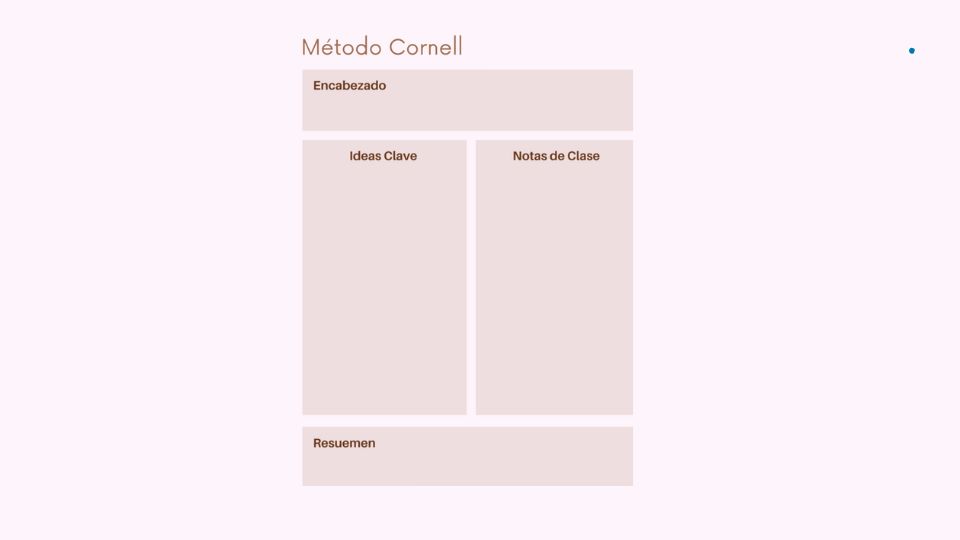
If you're looking for a more efficient way to take notes and improve your studying, the Cornell Method is just what you need. This system, developed in the 50s by Professor Walter Pauk of Cornell University, has proven to be an effective technique for improving information retention and making studying more productive. But how exactly does this method work, and how can you apply it to your own study habits? Let's find out!
1. What is the Cornell Method?
The Cornell Method is a simple yet powerful system for organizing your notes effectively. It divides notes into sections on a single page to help you take notes , process information , and review more efficiently. The best part is that all you need is a notebook or a word processor to use it.
Advantages of the Cornell Method:
- It facilitates the organization of ideas.
- It helps you to identify key points from a lesson or text.
- It is ideal to do effective reviews without losing time.
- Improves information retention thanks to its structure.
2. How to Structure Your Notes with the Cornell Method
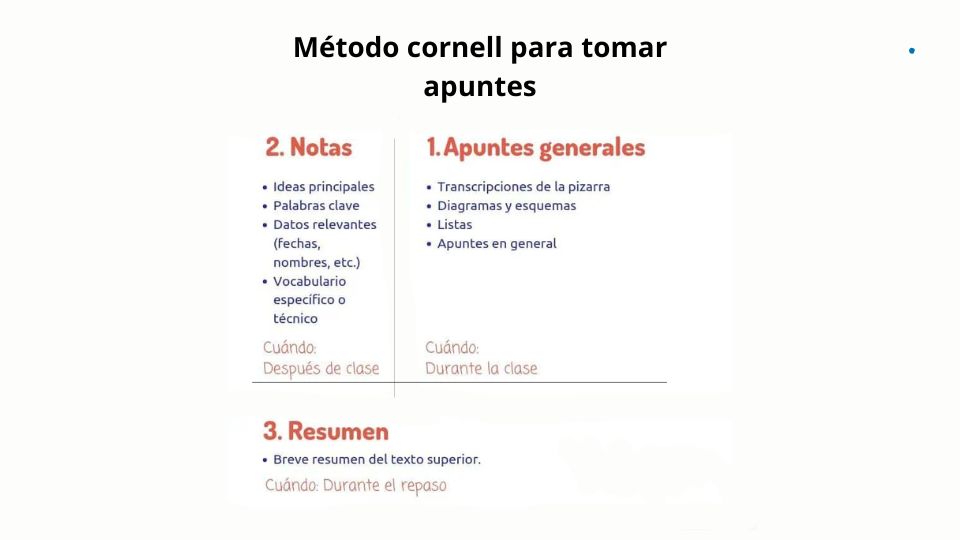
To apply the Cornell Method, you need to organize your sheet into three main sections . Here's how to do it step by step.
2.1. The Notes Section
This is the largest part of the page, usually the right-hand side , where you'll jot down key information during class or while reading a text. This is where you should write down notes , key phrases, or important concepts that you consider essential.
Key tip: Use a clear and concise note-taking style, without going into too much detail. The goal is to make it easy to review later.
2.2. The Questions or Keywords Section
The next step is to create a smaller column on the left, where you'll write down questions, keywords, or topics . This is crucial for when you need to do quick reviews . Once you've finished the class or reading, review your notes and jot down questions you can ask yourself to check if you truly understood the material.
What is this section for?
- Makes it easier to review without having to reread all the notes.
- Lets remember important concepts just looking at the keywords.
- It helps you prepare questions for an exam.
2.3. The Summary Section
The bottom section of the page is for the summary . After taking your notes, at the end of your study session or class, take a few minutes to summarize the information in your own words. This is the time to condense what you've learned and make sense of it in a few sentences.
Tip: Making this summary helps solidify your understanding of the topic and provides a quick reference point for future reviews.
3. How to Apply the Cornell Method to Your Study Technique
Now that you know the basic structure of the Cornell Method , it's time to apply it to your studies. Here's how to do it effectively.
3.1. Taking Notes During Class or Reading
During a class or while reading a text, use the Notes section to jot down key points. Don't worry about making it perfect; the important thing is to capture the essence of what's being taught. If you're using a word processor, you can even leave space between the lines to add more information later.
Practical tip: If you feel like you're falling behind in note-taking, simply write down key ideas that you can expand on later.
3.2. Review and Complete Notes Afterward
Once you finish the class or reading, go back to your notes and review them . As you review, add questions in the left-hand column . This will help you better process the information and check your understanding.
What kind of questions to ask?
- Questions that might appear on an exam.
- Questions that challenge your deep understanding of the topic.
- Definitions or explanations you might need to remember.
3.3. Summarize what you have learned
After reviewing your notes, use the Summary section to write a short synopsis of what you learned. Keep it brief but clear. This summary will be useful when you want to quickly review before an exam or presentation.
4. Tips to Maximize the Cornell Method

The Cornell Method is incredibly flexible and adapts to different learning styles. Here are some additional tips to help you get the most out of it.
4.1. Customize Questions and Keywords
Not all lessons or readings are the same, so don't be afraid to personalize your questions . If a topic is particularly difficult, you can ask more complex questions in the left-hand column. If it's something simple, keep the questions simple.
4.2. Review Your Notes Regularly
Don't wait until the day before an exam to review your notes. A key aspect of the Cornell Method is that it facilitates regular review. Dedicate a few minutes each week to reviewing key questions and your summary ; this way, you'll reinforce your memory and avoid having to do all the work at once.
4.3. Use Colors or Highlighters
If you're a visual learner, consider using colors to differentiate important parts of your notes. You can use different colors to highlight key topics , difficult questions, or important concepts in your summary.
5. Benefits of the Cornell Method for Students
The Cornell Method has many benefits that can help you be more efficient and improve your academic results.
- Clear and effective organization: Allows you to structure your notes in a way that is easy to understand and review.
- Faster and more efficient reviewsBy breaking your notes down into key questions and summaries, you can review in minutes instead of rereading entire pages.
- Improves information retention: By forcing yourself to process information through questions and summaries, you increase your chances of remember concepts in the long term.
- Ideal for exams: It helps you generate key questions that might appear on an exam, allowing you to prepare more efficiently.
The Cornell Method is one of the most effective techniques for organizing your notes and improving your studying. By dividing the page into sections for note-taking , asking key questions , and summarizing information , you can study smarter, not harder. So if you're looking to improve your academic performance, don't hesitate to apply this method to your study routine. Get ready to see results!