- The LOMLOE prioritizes equity, inclusion, sustainability, and digital competence with a competency-based curriculum and continuous assessment.
- It reorganizes Early Childhood, Primary (three cycles), ESO (4th year guidance) and Baccalaureate (new general modality and single access to university).
- Strengthens vocational training (basic, secondary, higher, and specialized), recognition of competencies, and artistic education with degrees equivalent to a Bachelor's degree.
- It strengthens participation, admission without segregation, genuine free tuition, rural schools, teacher training, and inspections with evaluations without rankings.
The LOMLOE is the latest major reform of the Spanish education system and, like any organic law, it reorganizes everything from the aims of education to assessment, admissions, and the organization of schools. More than just a change of subjects or exams, it seeks to update the system to meet the social, digital, and equity challenges we face today.
If you are a teacher, a candidate for competitive examinations, or part of a management team, it's essential to understand this from beginning to end. Below you will find a comprehensive guide, written in plain language, that summarizes the legal content, the key changes at each stage, and how they impact curriculum, qualifications, and school governance , including references to their subsequent regulatory implementation.
What is the LOMLOE and why is it approved?
Organic Law 3/2020 modifies the LOE of 2006 and supersedes the LOMCE of 2013. Its preamble begins by recalling that education is the essential means for the development of the person and social cohesion , and it adopts the European and UNESCO diagnoses for the decade 2020/2030.
With this guiding principle, the law establishes five cross-cutting approaches: children's rights, gender equality and co-education, inclusion with personalized learning, sustainability/global citizenship , and a strong focus on digital transformation (for both students and teachers) and the knowledge society . All of these aim to strengthen the equity and inclusive capacity of the system.
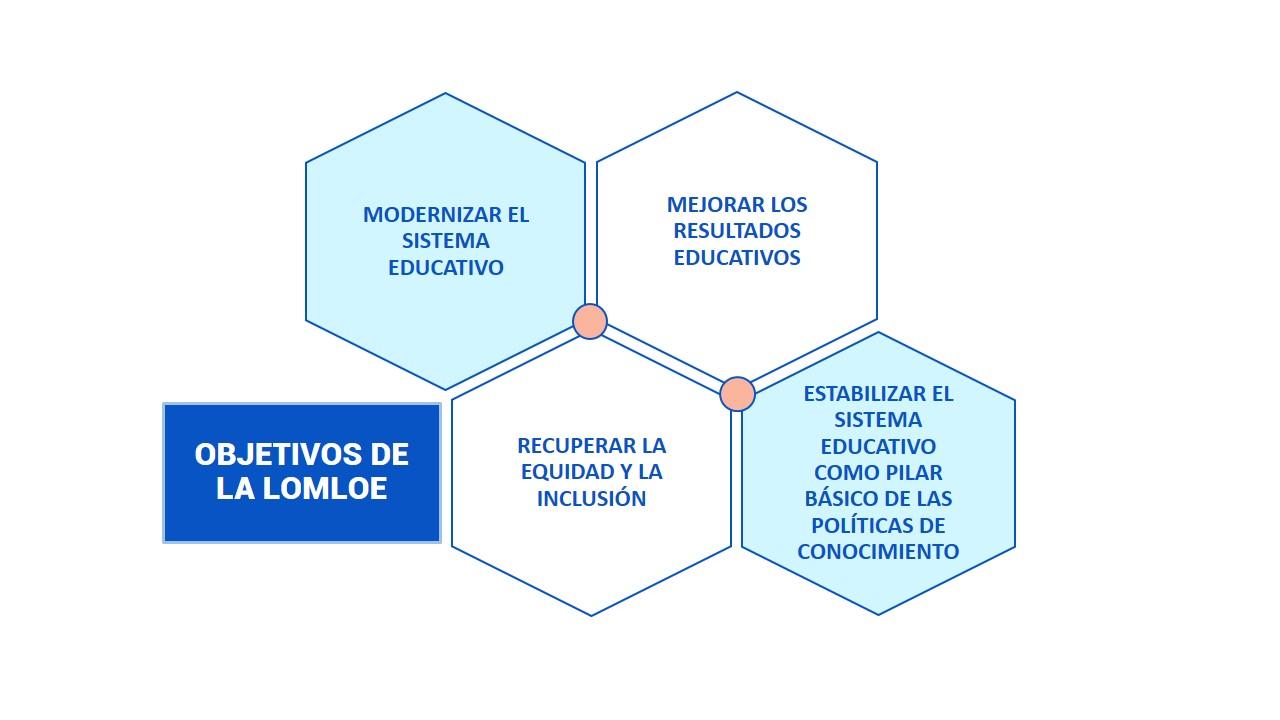
The reform also seeks to restore the balance disrupted by the LOMCE (for example, regarding participation and the role of collegiate bodies). End-of-stage standardized tests are eliminated, a competency-based curriculum design is reinstated, and continuous, formative, and integrative assessment is consolidated . The distribution of powers between the central government and the autonomous communities in curriculum development is also rebalanced: minimum state-level requirements of 50% in territories with a co-official language and 60% in others.
The ultimate goal is twofold: to improve outcomes by reducing school dropout and failure rates, and to stabilize the system as a matter of state policy . Within this framework, the law incorporates SDG 4 (quality education), democratic memory, education for peace and human rights, as well as education for health and active mobility.
Structural changes: curriculum, system evaluation and digitalization
The LOMLOE redefines the curriculum as a set of objectives, skills, content, methods, and assessment criteria (and learning outcomes in vocational training). The curriculum must serve an inclusive, skills-based, and barrier-free education, and will be reviewed periodically to adapt to advances in knowledge and new requirements . A unit is created within the Ministry to update the minimum learning standards, cooperating with the autonomous communities.
The basis is established for mixed curricula with other educational systems (leading to respective degrees) and territorial cooperation programs are strengthened for equity, cohesion and the appreciation of multilingualism and cultural diversity.
Regarding system evaluation, there are several key components: internal diagnostic assessments in the 4th year of Primary and the 2nd year of Secondary Education; multi-year sample assessments in the final years of Primary and Secondary Education ; and a State System of Indicators that incorporates the dimension of equity (always disaggregated by sex). The results may not be used to rank schools or to make individual student evaluations public.
The law mandates a strong push for digital culture: interoperable and accessible virtual learning environments, frameworks for digital teaching competence, and guaranteed access to digital resources for all students . Schools are required to develop a digital strategy, and public administrations are asked to implement measures against the risks of inappropriate ICT use (with particular attention to online violence and gender stereotypes).
Alongside this, commitments to democratic memory are incorporated (with a gender focus and attention to the Holocaust and struggles for rights), education for sustainable development , and a Contingency Plan to maintain educational activity in emergencies, with curricular and organizational measures and a focus on closing digital divides.
Educational stages: Early childhood, primary, secondary and high school
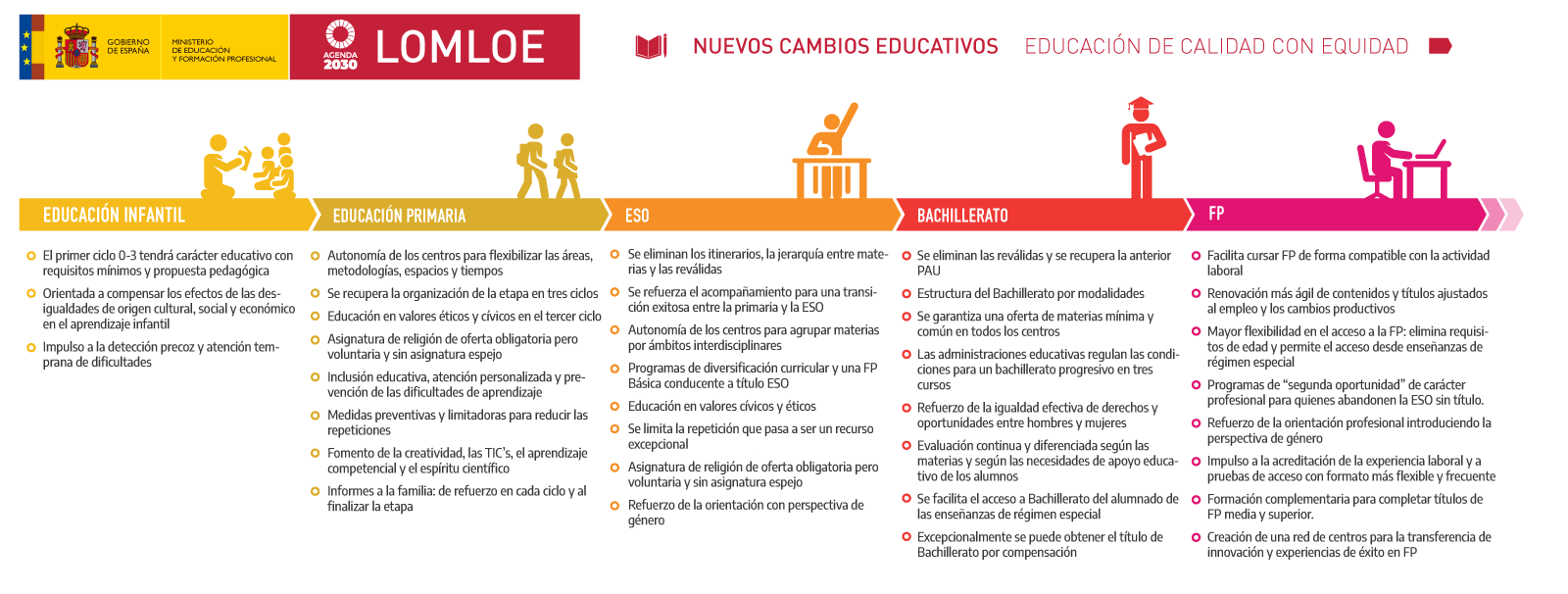
Early Childhood Education (0–6) . This stage maintains its two cycles with a distinct educational identity, working closely with families and addressing inequalities of origin. Emphasis is placed on respect for childhood culture, early detection and intervention , with content focused on socialization, emotional management, healthy habits, early initiations (not required for Primary Education), and methods based on play and positive experiences in nurturing and trusting environments.
The regulations stipulate that the second cycle is free , with sufficient provision through the public network and subsidized private schools; and the public provision of the first cycle (ages 0-3) is progressively promoted through medium-term plans, guaranteeing requirements and supervision. Coordination with Primary Education must ensure positive transitions, with a report from the tutor at the end of the stage.
Primary Education . The three two-year cycles return , organized into subject areas that may be further subdivided. Civic and Ethical Values Education (Human Rights, Constitution, sustainable development, tax justice, equality, and respect for diversity) is incorporated into some years of the third cycle. Religion is offered as a compulsory subject, but students choose it as an optional subject. Daily reading , digital literacy, creativity, and meaningful projects are integrated into all subject areas.
Assessment is continuous and comprehensive, focused on criteria and competencies ; grade repetition is only permitted in exceptional circumstances and, at most, once during the entire stage, with an individualized support plan. In the fourth year, a diagnostic assessment is carried out for informational and guidance purposes for schools, students, and families, and the relevant authorities promote improvement plans.
Compulsory Secondary Education . ESO reinforces competency-based, meaningful, autonomous, and reflective learning in all subjects, with opportunities for integration across subject areas and a range of electives that includes Classical Culture, a second foreign language, and a subject for developing digital competence (its availability is guaranteed). In the fourth year, which is orientation-oriented , students choose three subjects from a national set, with groupings that guide them towards upper secondary education (Bachillerato) and vocational training (FP).
All students will take Civic and Ethical Values Education . Curriculum diversification programs will be reinstated from the third year onwards for those who need them, with specific methodologies and geared towards obtaining a qualification. Promotion is decided collectively by the teaching team, with limited repetition (once per year, a maximum of two in compulsory education, with the possibility of an exceptional additional year in the fourth year). A diagnostic assessment is carried out in the second year.
Basic Vocational Training is organized by subject areas (Communication and Social Sciences, Applied Sciences, and Professional), with enhanced tutoring, guidance, and socio-educational support, as well as cooperation with community stakeholders. Those who complete a basic vocational training cycle receive a Secondary Education Certificate (ESO) and a Basic Technician Certificate ; those who do not complete it receive an academic certificate that can be used for partial accreditation.
Those who achieve the competencies of the stage receive a degree in ESO , with access to Baccalaureate or intermediate-level FP; those who do not receive an official certification and individualized guidance advice.
Baccalaureate . The tracks are Science and Technology, Humanities and Social Sciences, Arts, and General . The Baccalaureate is organized with core subjects, specialized subjects, and electives; the government regulates the structure and minimum number of subjects, and it can be completed in three years under the standard system when personal circumstances allow. Assessment is continuous and differentiated by subject; students progress from the first to the second year with up to two failing grades , and exceptionally, it is possible to graduate with one failed subject if the objectives and competencies for the qualification are demonstrated.
To access university, a single entrance exam is required (in addition to the academic record), with basic state characteristics, organized by public administrations and universities, with accessibility and non-discrimination measures.
Vocational training and special regime teachings
Vocational training within the education system encompasses basic, intermediate, and advanced levels , as well as specialization courses , all structured in modules and including work placements (exemption is granted for those with accredited experience). Qualifications are referenced in the National Catalogue of Qualifications and aligned with the National Qualifications System, which includes mechanisms for the rapid updating of core curriculum elements.
Access: Basic Level from age 15 (reached during the year), after 3rd year of ESO (exceptionally 2nd year) and recommendation of the teaching staff; Intermediate Level with ESO qualification, specific course or entrance exam; Higher Level with Baccalaureate, Intermediate Level Technician, specific course, entrance exam or higher/university degrees. Entrance exams adapted to the professional profile are considered where appropriate, and preparatory courses with partial exemption effects.
Assessment is carried out by modules (by subject areas at the basic level), and successful completion of the program entitles students to the qualifications of Technician/Advanced Technician , with access to higher levels (including university through admission and credit transfer procedures). Dual vocational training and specific programs for adults without qualifications are being promoted, in addition to a stable system for the recognition and accreditation of professional skills acquired through work experience or non-formal means.
Artistic and sports education: Higher education in Music, Dance, Dramatic Arts, Conservation and Restoration, Visual Arts and Design, and Design leads to qualifications equivalent to a university degree . Access requirements, specific entrance exams, credit transfers, and curriculum updates are regulated. In the professional arts field, those who complete professional studies in Music or Dance can obtain a Bachelor's degree in the Arts track by passing the common subjects.
Equity, student admissions and network of centers
The LOMLOE dedicates a specific section to equity, with measures addressing diversity, educational compensation, and combating segregation . It mandates a balanced proportion of students with special educational needs (SEN) in publicly funded schools, with adequate staffing and resources, and, where necessary, adjustments to student-teacher ratios.
In the admissions process, dignity and non-discrimination are guaranteed , and priority criteria (siblings already at the school, proximity, per capita income) and complementary criteria (large families, single-parent families, multiple births, disability, victims of gender-based violence or terrorism, parents working at the school) are established. Guarantee committees are formed to oversee processes and ensure a balanced enrollment of vulnerable students.
The guarantee of free education is protected : charging for free education, imposing contributions to foundations, or associating mandatory services that require family payments are prohibited. Regular extracurricular activities cannot be part of the school timetable, and the authorities must provide resources to ensure that socioeconomic status is not a barrier.
The allocation of places must ensure sufficient public offerings in all areas and promote social cohesion. Priority is given to agreements for basic vocational training programs in publicly funded private schools that offer them and address needs, provide relevant experiences, and encourage local schooling.
In rural areas, public administrations guarantee free school places in primary education in the municipality or area , transport, meals and boarding where appropriate, and promote post-compulsory education linked to the environment, reasonable adjustment of optional subjects and the provision of human and digital resources.
Participation is strengthened with a School Council with restored powers (approval of projects and PGA, admission, coexistence, monitoring of results, improvement plans and equality initiatives) and a management team selected by a committee in the center (with teacher and School Council representation), with mandatory specific training and the possibility of renewal after a positive evaluation.
The law promotes schools as sustainable spaces open to the environment , promotes safe school routes, active mobility and welfare and protection measures (including the figure of the welfare coordinator) and actions against harassment, cyberbullying, sexual and gender violence.
Teaching staff, training, inspection and evaluation
To teach ESO (Compulsory Secondary Education), Bachillerato (Upper Secondary Education), and FP ( Vocational Training), a university degree and postgraduate pedagogical training are required (Art. 100). The FP Technical Teachers Corps is being phased out , with integration into the Secondary Education corps being considered for those who meet the requirements. Public Administrations may hire specialist teachers from the productive sector under employment contracts.
Continuing professional development should encompass scientific and pedagogical updates, coordination, mentoring, inclusion, and attention to diversity; it includes specific training in equality, prevention of gender-based violence, harassment and child abuse , as well as digital competence and foreign languages. It is anticipated that the evaluation of teaching performance will be given preferential consideration in transfer and professional development competitions.
The Education Inspectorate strengthens its functions of pedagogical and organizational supervision, guidance for management teams, evaluation of the system, and guarantee of rights, guided by principles of respect for fundamental rights, professionalism, impartiality, efficiency, and transparency. The State maintains the High Inspectorate to verify compliance with basic competencies and standards.
Implementation and regulatory development schedule
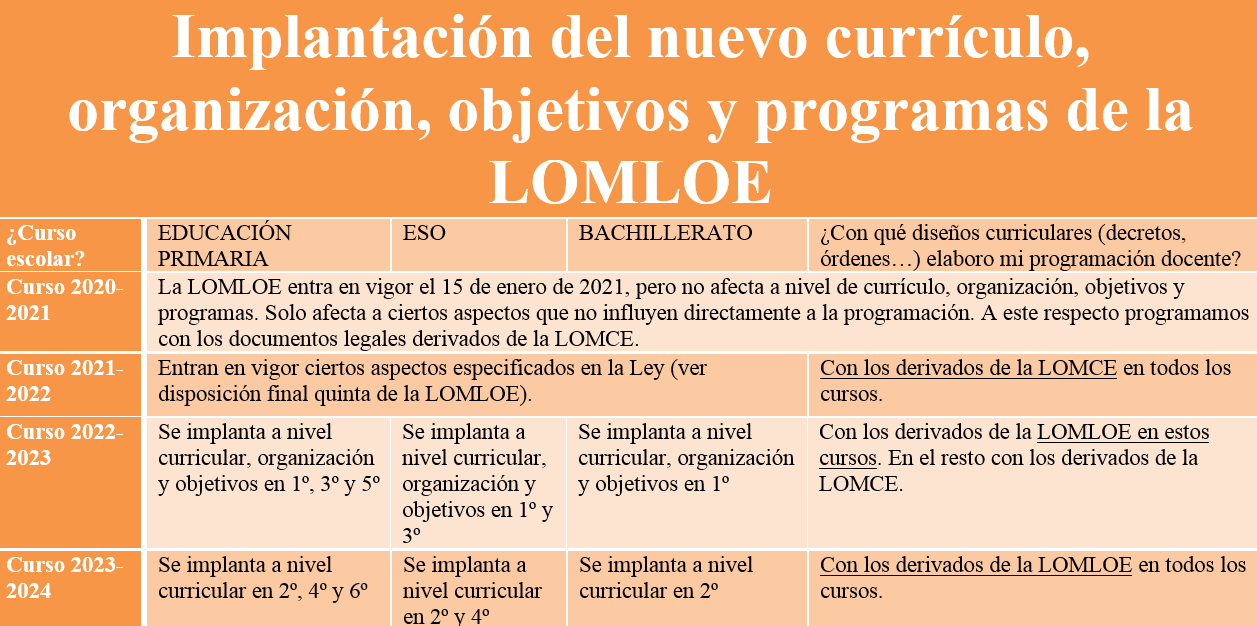
The law came into effect 20 days after its publication in the Official State Gazette (30/12/2020). Changes regarding the participation and powers of the School Council, the Faculty, and the school administration; school autonomy; the selection of school leadership; and student admissions were implemented immediately . At the beginning of the following academic year, modifications were implemented concerning assessment and promotion between educational stages, graduation requirements for Compulsory Secondary Education (ESO), Baccalaureate, and Basic Vocational Training, and access to educational programs.
The curriculum rollout was staggered: Primary (grades 1, 3, and 5 one year; grades 2, 4, and 6 the next), Secondary (grades 1 and 3 one year; grades 2 and 4 the next), and Baccalaureate (grade 1 one year, grade 2 the next). Diagnostic assessments began in the grades in which grade 4 of Primary and grade 2 of Secondary were implemented; and the new university access system was activated with the implementation of grade 2 of Baccalaureate.
To establish the minimum curriculum requirements, the State approved the Royal Decrees on minimum educational standards: RD 157/2022 (Primary Education), RD 217/2022 (Compulsory Secondary Education) and RD 243/2022 (Upper Secondary Education) . The subject of Civic and Ethical Values, competency-based assessment, the cross-curricular integration of digital competence, and meaningful projects form the backbone of these core curricula.
In parallel, the LOMLOE draws lines on other fronts: Spanish language and co-official languages (full and equivalent mastery upon completion of basic education); aid and book loans ; promotion of physical activity and healthy eating; road safety education and safe mobility; and procedures for accrediting skills to facilitate academic and professional progression.
For daily teaching and competitive examinations, this framework translates into didactic programs focused on competencies, UDL (Universal Design for Learning), continuous assessment with varied instruments, co-education and integration of digital competence , in addition to the necessary alignment with the criteria and operational descriptors set in the regional development regulations.
The LOMLOE is not just a list of changes; it reformulates the why (purposes), the what (curriculum), the how (methodologies and evaluation), the who (participation and teaching profession) and the where (organization and network of centers) , with a strong emphasis on equity, inclusion, sustainability and digitalization, and with system evaluation tools that avoid rankings and focus on continuous improvement.