- Acts as a critical mediator between creative and technical teams to optimize visual performance.
- Master scripting tools, graphics engines, and procedural workflows.
- Their profile is versatile, capable of leaning towards pipeline automation or the creation of complex visual effects.
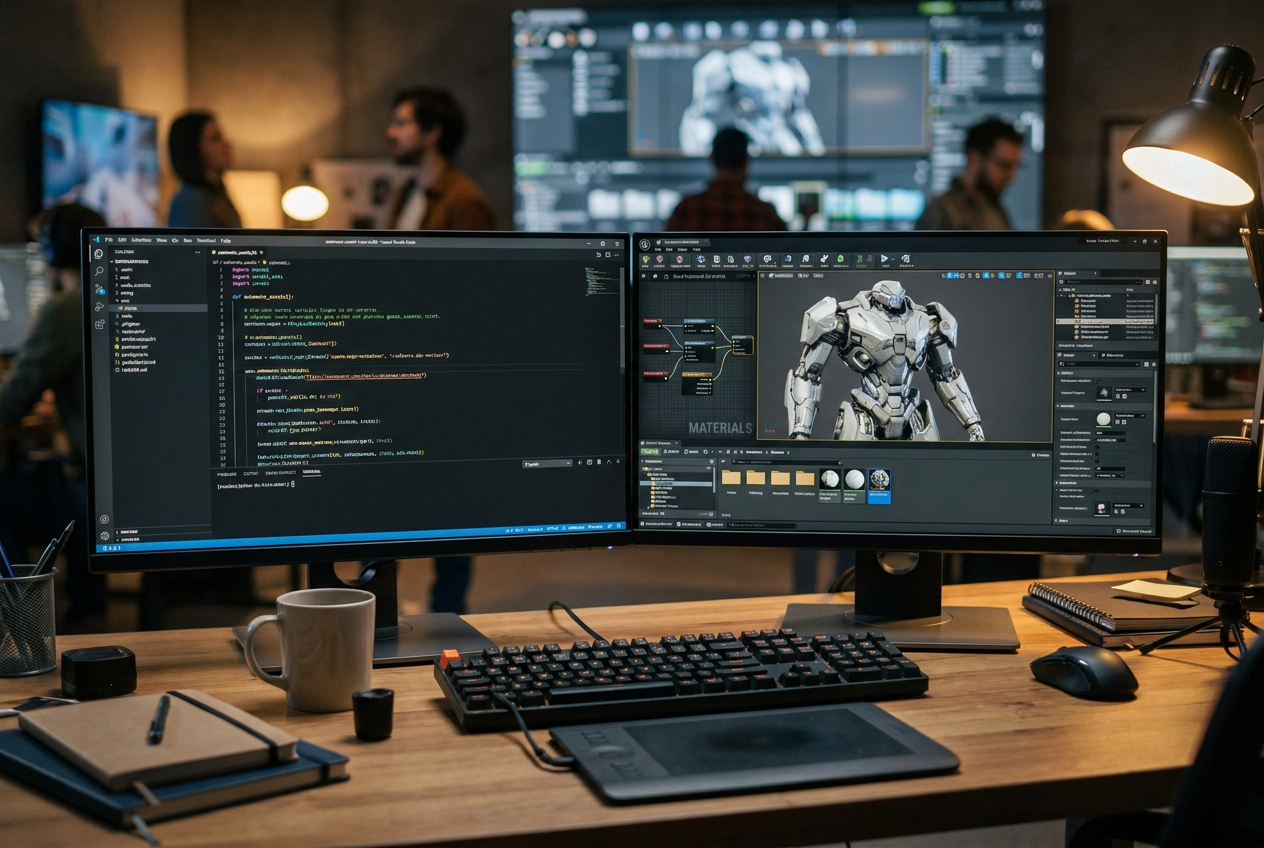
If you delve into the world of video game development or audiovisual production , you'll realize there's a figure who's the true glue of the team: the Technical Artist. Essentially, this is a hybrid role, capable of speaking two distinct languages: the visual language of artists and the logical language of programmers, ensuring that even the wildest and most ambitious ideas can be executed without the game engine crashing in the process.
It's not simply someone who knows how to draw and program a little, but a professional who balances aesthetics with technical efficiency . Their goal is for the final result to look incredible, but also to function smoothly, optimizing every resource to ensure a flawless user experience, whether it's in a AAA title, a virtual reality application, or a live television news broadcast.

What does your job actually consist of?
The Technical Artist is often described as a bridge, but in practice, this translates into very specific tasks. One of their main responsibilities is creating and maintaining pipelines , which is simply designing the path an asset follows from modeling to its appearance on screen. To do this, they typically use scripts in Python, C#, or MEL, automating tedious processes so that artists don't waste time on repetitive tasks and can fully focus on the creative side.
They also handle the technical integration of visual elements. This involves adjusting the polygon count, managing texture weight, and configuring shaders to ensure realistic lighting and materials. They are also responsible for monitoring FPS and memory usage , detecting collision bugs or performance issues that could ruin the game.
The versatility of the profile: no two are alike.
Interestingly, the title of "Technical Artist" can vary greatly depending on the studio. Some professionals are almost pure programmers , dedicating their time to writing complex internal tools and optimizing software architecture. At the other extreme, we find much more artistic profiles that use technology simply as a means to achieve a specific visual effect, perhaps relying more on visual tools like Unreal Engine Blueprints than on pure code.

There is also a strong overlap with the role of the Technical Animator. In this case, the work focuses on building rigs and control systems , allowing characters to move naturally. It's common to see animators who have gradually accumulated layers of technical knowledge, becoming essential for the seamless integration of motion capture and facial animations into the graphics engine.
Essential skills and tools
To excel in this role, a diverse toolkit is essential. On the artistic side, mastering the principles of composition, color, and lighting is vital, along with a knack for advanced shader design and high-precision texturing. On the technical side, proficiency in languages like Python, C++, and JavaScript is key to automating workflows and creating custom tools.
Regarding software, the Technical Artist typically switches between various applications depending on the project's needs:
- Graphics Engines: Unreal Engine and Unity are the standard for integrating all content.
- Modeling and Rigging: Tools such as Autodesk Maya, 3ds Max, Blender or Cinema 4D.
- Effects and Procedural Matters: Houdini is key to generating procedural content, along with the JangaFX suite for fluid, fire, or smoke simulations.
- Texturing and Post-production: Substance Painter, Photoshop and After Effects.

Even today, the integration of artificial intelligence is beginning to play a significant role. AI-powered 3D generation tools enable rapid prototyping, accelerating the pre-production phase and allowing the technical artist to refine the final details much more efficiently.
Training, job prospects and salaries
Becoming a Technical Artist typically requires a mixed background. Many start with degrees in Computer Science, Software Engineering, or Digital Art, supplementing them with specialized courses in scripting and game engines. Ideally, structured education should be combined with real-world experience in collaborative projects or internships, as this is where you truly learn to solve the technical problems that arise in production.
Regarding the job market, demand is extremely high due to the shortage of professionals with expertise in both areas. In Spain, a junior professional can start at around €20.000, although the average for someone with experience is usually between €30.000 and €35.000 annually , potentially reaching up to €60.000 in larger studios. Internationally, the figures are even more attractive, ranging from $45.000 to over $100.000, especially in elite studios that offer the possibility of working remotely from anywhere.
This discipline has become an irreplaceable pillar of modern industry. By combining the ability to program efficient tools with a keen aesthetic sensibility, the Technical Artist not only optimizes production but also allows the artistic vision to reach its full technical potential, making a difference in the visual quality and fluidity of today's digital worlds.