- An ERA isolates the user and supplies respirable air in hazardous atmospheres.
- There are open and closed circuit devices, with different autonomy and uses.
- Regular maintenance and inspections ensure reliability and safety.
When the air around us is unsafe, having self-contained breathing apparatus (SCBA) makes the difference between being able to act calmly and having to evacuate immediately. In environments with smoke, toxic gases, or a lack of oxygen, these devices provide breathable air independent of the atmosphere , allowing work or rescue operations to be carried out safely. And yes, it's not just for firefighters: they are also used in mining, the chemical industry, confined space rescues, and industrial emergencies.
If you're wondering exactly what a SCBA is, how it works, and what to look for to choose and maintain one properly, this is a comprehensive guide. We cover key concepts, existing types, components, and standards, along with maintenance and inspection guidelines that make all the difference in safety. You'll find practical examples, recommendations, and the terminology used daily by emergency response teams.
What is a self-contained breathing apparatus and what is it used for?
A Self-Contained Breathing Apparatus (SCBA) is a respiratory protection device that supplies the user with clean, breathable air through a sealed face mask, completely isolating them from the outside environment. Its purpose is twofold: to ensure a breathable atmosphere and to protect the face from splashes, heat, and contaminants present in the environment.
These devices are used when there is an oxygen deficiency or the presence of hazardous substances (gases, fumes, aerosols, particles). They are essential for firefighters, industrial brigades, rescue teams, mining personnel, chemical or nuclear plant operators, and, in general, for interventions in confined spaces with atmospheric risks.
Common applications and risk scenarios
Self-contained breathing apparatus (SCBA) interventions encompass a wide range of activities: from urban and industrial fires to underground rescues and work in warehouses containing hazardous materials. In all these cases, the aim is to isolate the professional from the harmful agent and ensure respiratory autonomy for the time necessary to act effectively and safely.
Common examples include smelting furnaces with asphyxiating fumes, mine shafts with toxic emissions, and underground spaces with low oxygen levels . Furthermore, these heat- and fire-resistant devices are ideal for use by firefighters and fire brigades.
Types of air supply equipment in ERA
Self-contained breathing apparatus (SCBA) is divided into two main categories based on how it manages breathing air. This classification determines its autonomy, weight, and recommended use. Broadly speaking, you'll find open-circuit and closed-circuit systems , each with its own operating principles and specific advantages.
Open circuit equipment
In an open-circuit SCBA, the user breathes compressed air stored in a high-pressure cylinder. The air is pre-filtered and delivered in a controlled manner to the mask. After inhalation, the exhaled air is expelled to the outside, simplifying the system and allowing for an immediate response to respiratory demand.
Typical components of an open-circuit device:
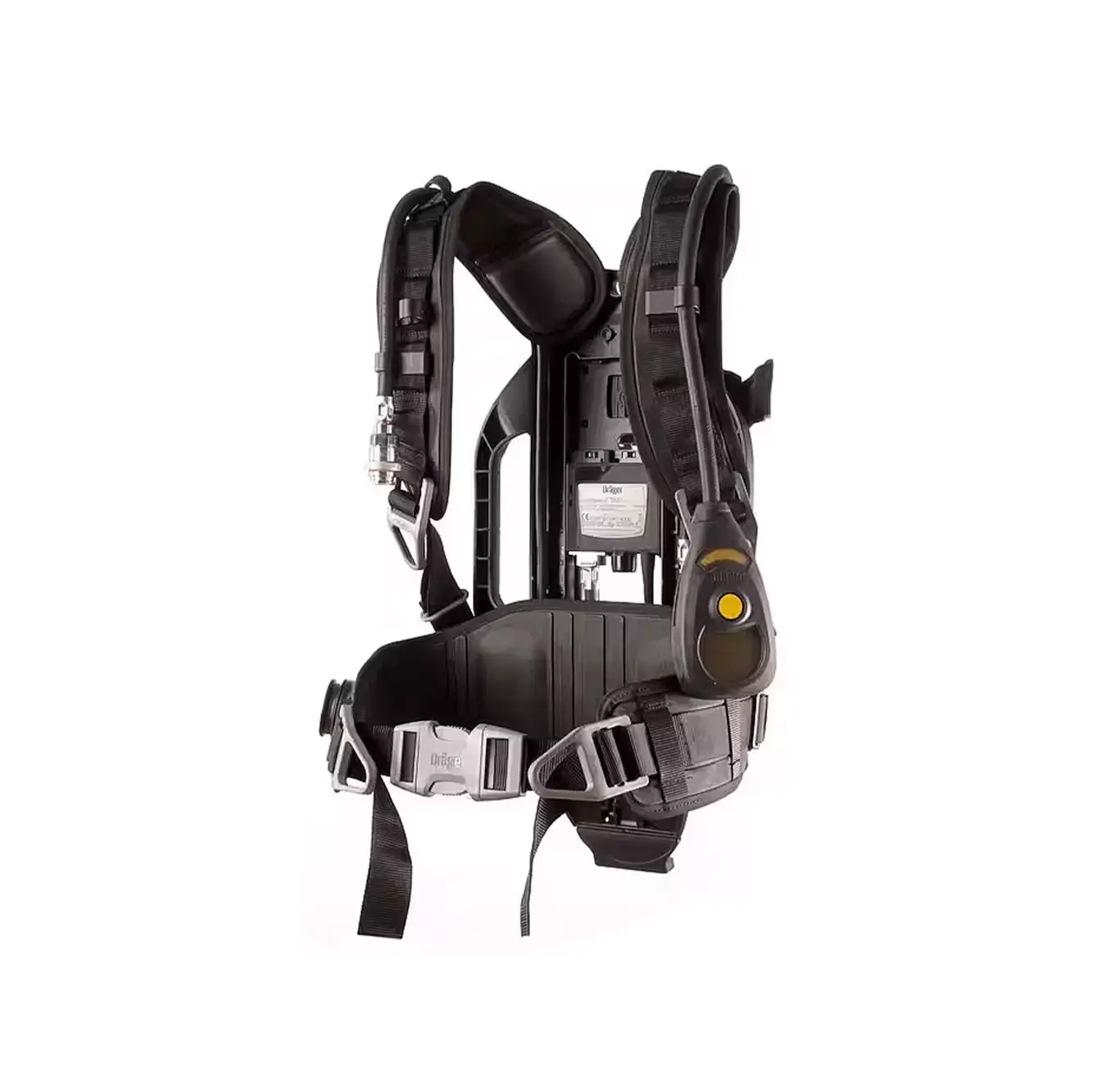
- Back Protector: structure and harnesses that adjust to the back and waist, providing support and comfort during transport of the set.
- pressure reducer: decompresses air from high to medium pressure, stabilizing the supply to the regulator and, in many models, to a control unit.
- Regulator: delivers air at the rate set by inhalation, maintaining output pressure at a level suitable for comfortable and safe breathing.
- Control unit (bodyguard): can integrate pressure gauge, calculation of remaining air time and, in certain equipment, parameter monitoring with audible and visual alarms.
- Face mask: seals the face, incorporates an exhalation valve and elements that improve communication (voice membrane) and interoperability with wireless systems.
- Bottle/cylinder: contains compressed air. The available volume is estimated by multiplying the geometric capacity by the loading pressure. For example, a 6 L cylinder at 300 bar provides approximately 1.800 liters of air at atmospheric pressure.
This type of SCBA is the most widely used in emergencies and rescues because it offers a direct and highly reliable supply of air. However, its autonomy is linked to the cylinder's capacity and the user's breathing demands, as well as the work pace and the ambient heat stress.
Closed circuit equipment
Closed-circuit SCBAs reuse exhaled air, which undergoes a chemical process to remove CO2 and moisture, and is then re-enriched with oxygen depending on the system. The key advantage of this design is its longer operating time and smaller size , resulting in lighter weight, greater maneuverability, and a more compact profile, ideal for extended interventions and in hard-to-reach areas.
Within the closed circuit, there are two main solutions :
- Regenerators: The air passes through a filter with mixtures such as calcium hydroxide and sodium hydroxide, which absorb the CO2. Oxygen is then added from a small integrated tank to restore the respirable fraction.
- Self-generators: They use compounds such as potassium phosphate (KO2), which, when exposed to moisture, transforms CO2 into oxygen. This makes the air breathable without external input, optimizing autonomy.
These configurations are chosen when long intervention times or mobility are prioritized, although they require specific training and rigorous control of the condition of the cartridge/filter and the generating system.
How they work in detail and how they have evolved
In practice, the operation of a SCBA (Self-Contained Breathing Apparatus) is based on the user inhaling breathable air through the mask while a differential pressure system, regulators, and valves maintain a stable and safe airflow . In an open circuit, exhaled air is expelled; in a closed circuit, it is recycled and chemically conditioned.
From the first rudimentary devices of the 20th century used by miners and firefighters, technology has advanced with lighter materials, improved ergonomic harnesses, built-in alarms , and control units that estimate remaining time or integrate telemetry. Improvements to masks and membranes have increased speech intelligibility, essential in tactical operations.
Quality standards and requirements that must be met
The safety of this equipment relies on its design and certification. Internationally, SCBAs must comply with standards such as EN 137 (open-circuit equipment) and EN 145 (closed-circuit equipment), in addition to NIOSH standards in the United States. These standards require testing for leaks, alarm reliability, material strength, and performance under demanding conditions.
Regarding the quality of breathable air, some countries set specific criteria. For example, in Colombia, the reference for breathable air is set out in Resolution 0491 of 2020 , which establishes purity and control parameters to guarantee that the supply is suitable for human use in work environments.
Keys to choosing the right ERA
Choosing a SCBA isn't just a matter of personal preference: the solution must be aligned with the risk and the planned work. Factors such as estimated intervention time, required mobility, heat level, communication compatibility, and, of course, actual air autonomy, determine the choice between open or closed circuit and the cylinder capacity.
Other relevant criteria include the overall weight of the unit, the design and fit of the back protector, ease of maintenance, the availability of clearly audible low-pressure alarms , and the ability to integrate accessories (e.g., wireless connections or adapters for goggles/helmets). Complete kits are also available that include a back protector, mask, and cylinder, ready for use and designed for durability and ease of handling.
Accessories and complementary equipment
In more demanding scenarios, SCBAs are often combined with helmets, visors, flame-resistant clothing, and other PPE . Full-face masks provide additional protection against impacts and splashes, while compressed air cylinders can offer various capacities and quick-connect fittings for faster replacement.
In addition, there are pre-configured kits and lightweight solutions designed for rapid intervention teams. The key is to assess whether the job will require extra protection (for example, against sparks or thermal radiation) and to verify the compatibility of all components to maintain a watertight seal and comfort.
Maintenance: Why it's critical and how to organize it
Even the best ERA can fail if it's not properly maintained. A preventative maintenance program, based on the manufacturer's guidelines, reduces the likelihood of incidents and ensures the equipment performs like new when it's needed most. This involves regular inspections, bench testing, and replacement of worn parts.
Good maintenance practices include: thorough cleaning and disinfection (to prevent mold and pathogens), inspection of the regulator and breathing apparatus, careful drying of components, replacement of critical elements (breathing units, valves, masks), and a final quality control check after assembly. When applicable, cylinders are filled in accordance with breathable air purity parameters.
The plan must be documented with task certificates and authorization signatures, and applied with a frequency appropriate to usage. In daily operating environments, the recommended guideline is to perform these operations at least monthly . In addition, cylinders must undergo periodic testing (every 3 to 5 years, depending on the material) and their lifespan is typically around 15 years if properly maintained.
Pre-inspections: verification before starting
Before each use, a quick but thorough check is recommended. Start by ensuring the straps and back support are fully extended and free of knots . Then confirm that the cylinder valve is closed to prevent accidental leaks during storage.
The next step is to open the valve to pressurize the system, close it, and check the pressure gauge to ensure the pressure does not drop below 10 bar in the following minute. Next, the circuit is purged, and it is verified that the low-pressure alarm triggers at approximately 55 bar. Finally, the valve is fully opened and then closed half a turn to prevent it from jamming due to impact. The equipment is then reinstalled, and the correct airflow is confirmed.
Risks of not using ERA where necessary
Working without respiratory protection in hazardous atmospheres exposes workers to poisoning, respiratory injuries, and life-threatening situations. A SCBA (Self-Contained Breathing Apparatus) prevents hazardous inhalation, allows for more informed decision-making, and, in the medium term, reduces occupational illnesses linked to chemical agents or particles. Ultimately, it's about protecting the worker and ensuring the safe continuity of operations.
Autonomy and its real limits
No SCBA is infinite. Its effective duration depends on the capacity of the cylinder or the regenerative medium, but also on physical exertion, temperature, and stress. Therefore, in addition to theoretical calculations, user training is crucial for managing breathing, recognizing alarms, and optimizing energy use during interventions. Monitoring and maintenance complete the cycle to prevent unexpected issues.
Technology to streamline inspections and control
Digitizing ERA control with inspection software simplifies everything. Dynamic checklists allow you to add photos, geolocation, signatures, and QR codes to identify equipment. This enables automatic reporting of non-conformities , assignment of responsibilities, and real-time monitoring of incident closures, even while working offline and syncing later.
Instant communication between inspectors and coordinators saves time and reduces errors. It also facilitates demonstrating protocol compliance and maintaining complete traceability throughout the equipment lifecycle: inspections, repairs, cylinder testing, and filling records.
Professional training and certification
The use of SCBA (Self-Contained Breathing Apparatus) requires specific training. In Spain, the Professional Certificate SEAD0111 qualifies individuals to perform firefighting and rescue tasks in fire services throughout the country. Beyond the certificate itself, the key is realistic training: proper mask placement and seal, air demand management, communication under stress, and emergency procedures.
If your organization needs to expand its capabilities, look for programs that include hands-on training, thermal simulations, and confined space exercises. And if budget is a concern, many organizations offer financing options to make this essential safety training more accessible.
Internal regulations, purchasing and after-sales service
In addition to complying with international standards, it is advisable to establish internal regulations that define responsibilities, selection criteria, critical spare parts inventory, and minimum autonomy levels required for each mission. When acquiring equipment, check certifications, warranty, consumable availability, and technical service response times.
If your environment demands specific solutions (for example, integration with communications or low-profile masks), consider suppliers that offer a variety of open and closed circuit SCBAs, different cylinder volumes, and integrated alarms with high acoustic and visual visibility.
Quick FAQ
Does a SCBA cylinder contain pure oxygen? In open-circuit systems, it's usually breathable compressed air, not pure oxygen. In closed-circuit systems, the mixture is chemically managed and can be supplied with oxygen from tanks or specific compounds.
How often are the cylinders tested? Generally, every 3 to 5 years, depending on the material and applicable legislation. Their lifespan is around 15 years if properly maintained, after which they must be removed and destroyed to prevent unsafe reuse.
What actual runtime can I expect? It depends on the cylinder/regenerator capacity, user demand, and working conditions. As a reference, a 6 L cylinder at 300 bar provides approximately 1.800 L of air at ambient pressure, but the runtime in minutes varies with the effort.
With all of the above in mind, it's clear that a SCBA is much more than just a cylinder and a mask: it's a complete protective system that, when properly selected, maintained, and used, saves lives and reduces risks in the harshest environments. Combining the right choice (open/closed), solid training, systematic inspections, and digital support for these checks provides the operational peace of mind that firefighters, rescue workers, and industrial teams need every day.