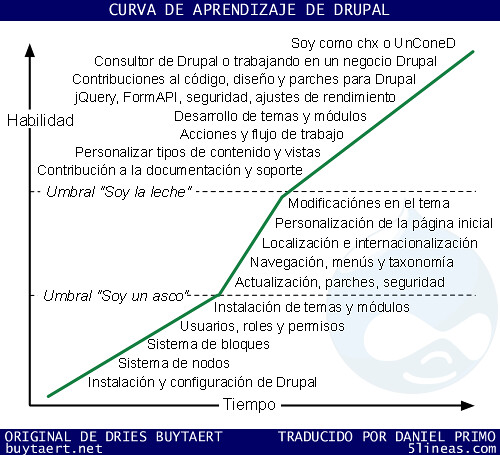
Definition of the learning curve
La learning curve It is a fundamental concept in the fields of education, psychology, and personal development. It refers to the relationship between the time or effort a person devotes to an activity and the performance they obtain throughout that process. It is often visualized as a graph in which the horizontal axis represents the learning time and the vertical axis represents the level of skill or knowledge acquired. As one progresses along this curve, learning growth tends to show an initial acceleration, followed by a gradual flattening.
The identification and understanding of the learning curve It is crucial in various fields. In the education sector, it allows teachers and educators to design programs that adapt to the learning pace of students. In the business field, it helps organizations set realistic expectations for employee training when implementing new technologies or processes. It also allows individuals to understand that persistence and practice are key to mastering new skills.
Phases of the learning curve
Phase 1: Initial learning
The first phase of the learning curve This is what is known as the phase of initial learningDuring this period, individuals often experience a upward curve Fast-paced. During this phase, the novelty of the material or skill being learned can be exciting and motivating. However, it can also be overwhelming, as many concepts and techniques are introduced for the first time.
Characteristics of the initial learning phase
- Fast progress:Individuals often experience a significant increase in their performance at the beginning of learning.
- FrustrationAs students face early challenges, they may become frustrated by their lack of experience.
- Curiosity and motivationNovelty is often a powerful stimulant, helping to maintain interest in learning.
Phase 2: Learning Plateau
The second phase, often referred to as the learning plateau, is characterized by a period of slower progression. During this stage, the individual may feel stuck, and their performance may not show significant improvements, despite continued practice.
Characteristics of the learning plateau
- Stagnation in performanceDespite continued efforts, progress may be limited or unclear.
- Demotivation:Frustrating moments of not seeing progress can lead some to give up on the activity or learning.
- Re-evaluation: This phase can prompt learners to re-evaluate their approaches and strategies.
Phase 3: Mastery and Domain
After the plateau, learners can enter the phase of mastery and dominanceAt this stage, individuals are able to handle the acquired skill or knowledge with confidence and fluency.
Characteristics of the master's phase
- Skill mastery: Skills are performed with ease and often without thinking about them.
- Incorporation of advances: At this stage, the apprentice can begin to incorporate more advanced techniques or specializations.
- Creativity: Skill and knowledge enable the learner to be more creative and experiment with new approaches.
Factors that influence the learning curve
There are multiple factors that can affect the learning curve, including:
Previous experience
Prior experience in a related field can significantly influence the learning curve. Those with a solid foundation may find they climb the curve more quickly than absolute beginners. For example, a musician learning a new instrument may find that their prior knowledge of music theory gives them an advantage.
Motivation and commitment
La and motivation This is another critical factor. Individuals who are highly motivated to learn, whether for personal or professional reasons, tend to perform better. Furthermore, commitment to practice and study is vital to advancing through the different stages of the learning curve.
Teaching quality
The quality of teaching and the support received also play an important role. An instructor who can provide clear explanations and helpful recommendations can help learners better navigate the curve. Conversely, a poor educational approach can lead to a less effective learning experience.
Learning style
Each person has a learning style different, which can influence how you approach new skills. Some people learn best through display, while others benefit more from kinesthetic practice or auditory methods. Recognizing and adapting to your own learning style can optimize progress.
How to optimize the learning process
To make the most of the learning curve, it is advisable to adopt strategies that facilitate the process:
Goal setting
Defining clear and achievable goals can provide direction and motivation. By establishing a path to follow, learners can stay focused and measure their progress effectively.
Deliberate practice
La deliberate practice It involves focusing on specific areas for improvement while challenging yourself. This approach can help prevent stagnation and encourage continued development in desired skills.
Constant feedback
Receiving regular feedback from instructors or peers can provide valuable insights into progress and areas that require attention. This feedback can act as a catalyst for advancing along the learning curve.
Flexibility and adaptation
Being flexible and willing to adjust strategies or approaches is essential for effective learning. Listening to the needs of your own learning process and adapting to new circumstances can facilitate more consistent progress.
Applications of the learning curve in different fields
La learning curve It is not limited to the academic field; its application extends to various areas:
Education
In the educational context, teachers can use the learning curve to personalize instruction and adapt the curriculum to the needs of individual students. Understanding the stages allows them to design interventions that help students overcome the plateau.
Companies and vocational training
Companies can apply this concept to develop more effective training programs. By understanding the stages their employees will go through, they can offer the right support and resources at the right time, thus maximizing the return on their training investment.
Personal growth
The field of personal development also benefits from understanding the learning curve. From learning a new language to mastering a musical instrument, this knowledge can help people set realistic expectations and stay motivated throughout their learning journey.
emerging technologies
In the digital age, the learning curve This becomes an even more relevant issue, as new technologies require rapid adaptation. Understanding how these curves operate can facilitate the adoption and mastery of emerging tools, from software to new digital platforms.
Technological advances and the learning curve
The evolution of technology has transformed the way we learn. Platforms such as MOOCs (massive open online courses) and learning apps have revolutionized access to education. However, the learning curve still applies to these platforms, as users must navigate different levels of complexity and adapt to new approaches.
Artificial intelligence and personalized learning
Artificial intelligence (AI) is beginning to influence the learning curve by personalizing education. Systems that analyze student performance in real time can make automatic adjustments to content or difficulty, facilitating more dynamic and fluid learning.
Augmented and virtual reality
The implementation of augmented reality (AR) and virtual reality (VR) technologies is creating new visual and immersive learning experiences. These tools can help accelerate the learning curve by enabling hands-on experiences that would otherwise be difficult to achieve.
Understand the learning curve It is essential for all those who wish to develop new skills or knowledge. By recognizing the stages we go through and the factors that influence the process, individuals and organizations can establish realistic expectations and effective strategies to address continuous learning. Adaptability, motivation, and the intention to practice are key elements that can make a difference in the success of the learning process. As we navigate the changing educational and technological landscape, understanding the learning curve becomes an invaluable tool that can optimize skill acquisition and personal development in any field. With the right strategies and the use of emerging technologies, it is possible to make the learning process more efficient, rewarding, and accessible for everyone.