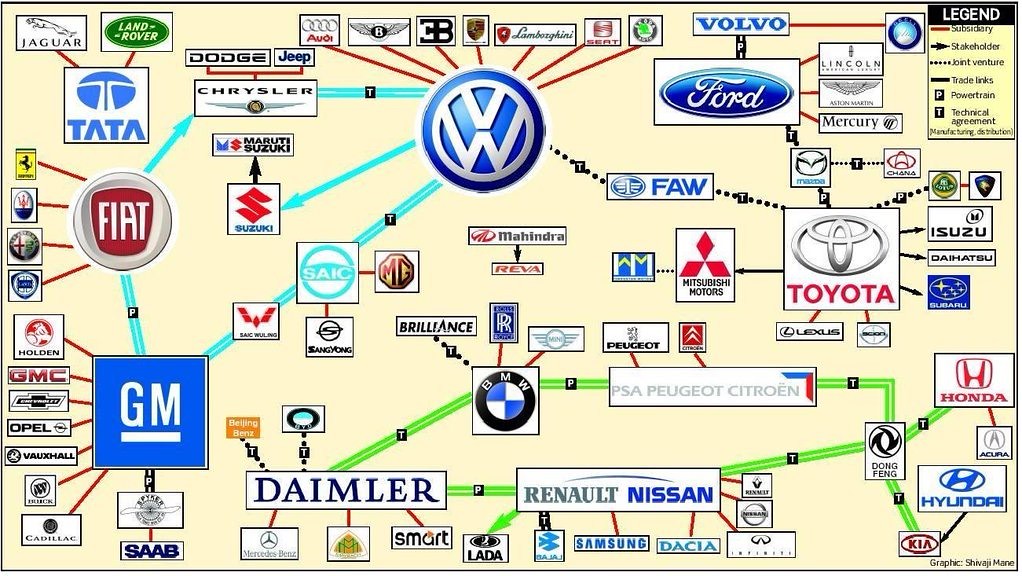
An oligopoly is a market structure characterized by a small number of firms that dominate the supply of a good or service. In this type of market, each firm has significant influence over the price and quantity produced, which distinguishes it from perfectly competitive and monopolistic models. The main characteristics and types of oligopoly are analyzed in detail below.
Characteristics of the Oligopoly
Few Dominant Companies
One of the most prominent characteristics of an oligopoly is the presence of few firms in the market. This limited number of competitors can lead to a situation where the decisions of one firm influence the actions of the others. This interdependence is fundamental to understanding oligopoly behavior.
Homogeneous or Differentiated Product
Oligopolies can offer homogeneous products , such as petroleum products, or differentiated products , such as automobiles. In oligopolies with homogeneous products, competition is based primarily on price, while in those with differentiated products, companies can compete on quality, features, and branding.
High Entry Barriers
Oligopolies are characterized by barriers to entry that make it difficult for new competitors to enter the market. These barriers can be economic, such as high investment costs, or legal, such as patents and regulations. The existence of these barriers contributes to market stability and the profitability of established companies.
Firms in an oligopoly often seek to coordinate their actions to maximize profits . This can manifest itself through collusive practices, where firms agree to fix prices, limit production, or divide the market. Although such conduct is illegal in many jurisdictions, it is difficult to detect and therefore persists in some markets.
Price Differentiation
Oligopolies also commonly practice price differentiation . This means that companies can set different prices for the same product, depending on market segmentation and consumer perception. This strategy helps them capture a larger market share and maximize revenue.
Main Types of Oligopoly
Perfect Oligopoly
In this type of market, companies offer identical products and there is a high degree of interdependence among them. Game theory is commonly applied to analyze the behavior of companies in this context. A classic example is the steel market , where a few companies control global production.
Imperfect Oligopoly
Unlike a perfect oligopoly, in an imperfect oligopoly, firms offer differentiated products. This introduces a greater degree of competition among oligopolists, who seek to compete not only on price but also on features and added value. An example is the automotive market, where different brands compete through the quality and design of their vehicles.
Oligopoly Duopoly
When only two companies compete in a market, it is called a duopoly . In this situation, each company has significant market power, and its strategic behavior can have a considerable impact on its rival. A classic example of a duopoly is the Boeing - Airbus market in the aerospace industry.
Oligopoly with Collusive Pricing
This variant occurs when companies collude to fix prices, virtually eliminating competition. While theoretically this may be beneficial for companies, it is detrimental to consumers, as it results in higher prices. OPEC is a clear example of an oligopoly with collusive pricing, where they agreed to reduce oil production in order to raise prices.
In this type of oligopoly, companies operate in markets where the final product is the primary focus. This can include industries like telecommunications or consumer electronics , where a few companies dominate the market. Different marketing techniques and product positioning strategies can also be observed here.
Prices and Competition
Oligopoly has significant implications for price formation . The interdependence among firms means that each must consider what the others do when setting prices. This can lead to price stability in the market, but it can also result in pricing practices that harm consumers.
Innovation and development
Companies operating in an oligopoly often have sufficient financial resources to invest in research and development . This can drive innovation and improve product quality, ultimately benefiting consumers. However, the incentive to innovate can diminish if companies believe they can maintain their market share without significant changes.
Oligopoly affects not only price distribution but also resource allocation. Because it is a controlled environment, companies can decide how to allocate their resources, which can impact the availability of products and services in the market. This can lead to inefficiencies in resource allocation, harming the economy as a whole.
Regulation and Public Policies
Oligopolies often attract the attention of regulators because of their ability to distort the market. Public policies may seek to promote competition and reduce the market power of these firms. This includes antitrust laws , price regulation, and other measures designed to protect consumers.
Oligopolies in the Digital Age
The advent of the digital economy has changed the nature of many oligopolies. Oligopolies are now forming in the technology sector, where giants like Google , Apple , Amazon , and Facebook dominate their respective fields. These companies not only compete with each other but also shape market behavior through their control over consumer attention.
New Barriers to Entry
Digital businesses often face lower barriers to entry than traditional markets, leading to a surge in startups seeking to challenge established giants. However, for these new companies to offer viable alternatives, they will need significant resources and innovative strategies to establish themselves in an already dominated market.
Effect on the Consumer
Oligopolies in the digital age can offer consumers advantages in terms of accessibility and service variety . However, they can also foster addictive behavior and data monopolization, raising ethical and privacy challenges. This balance is crucial for assessing the impact of oligopolies on today's society.