- A good summary condenses key ideas with clarity, objectivity, and an active voice.
- Choose the type (study, abstract, executive) according to the objective and audience.
- Effective process: read, underline, extract, structure, draft and review at 25%.
- Academic style: third person, present, without verbatim copies and with quotations.
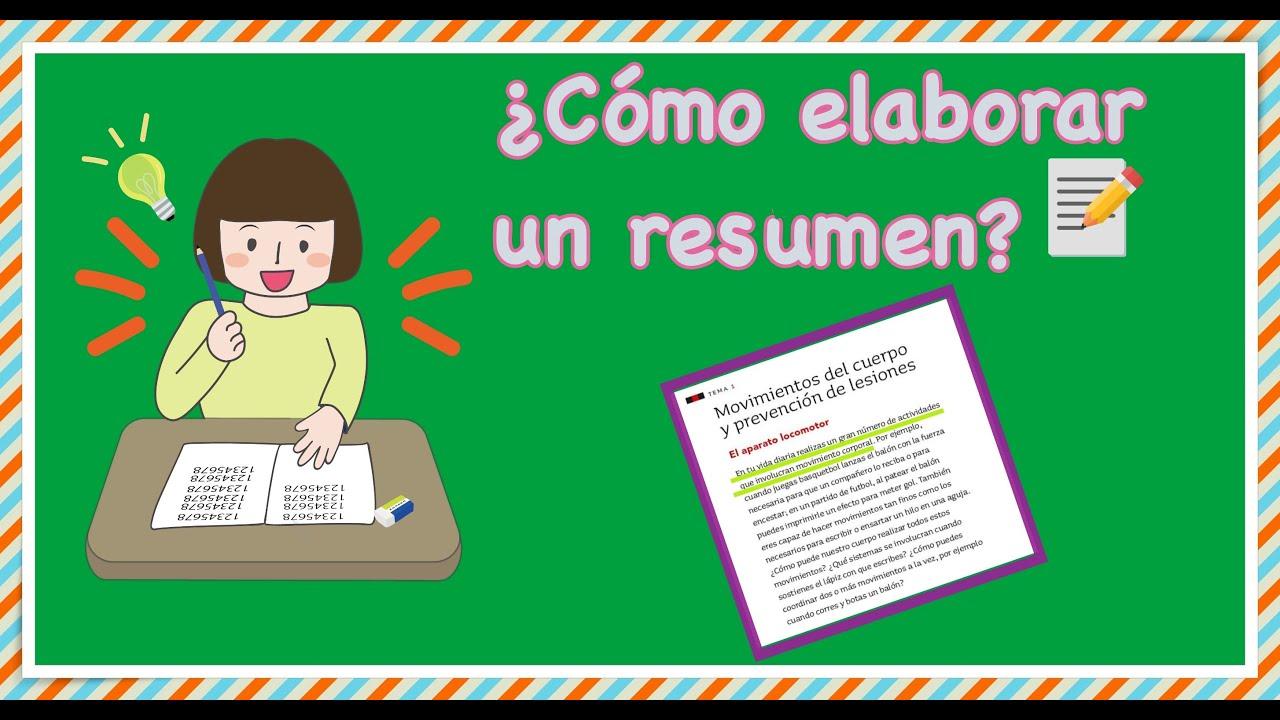
Creating a good summary isn't just about shortening; it's about distilling the essential elements of a text and reorganizing them clearly for better understanding, study, or communication. With the right technique, you can separate the important from the irrelevant, write in your own words, and create useful material that will save you time later.
In the following lines you'll find a complete guide with definitions, types, steps, structure, style tips, examples from different disciplines, and quick tricks (including how to get started and how to stick to 100 or 150-200 words). Everything is adapted to Spanish from Spain and has a practical approach so you can apply it today.
What is a summary and what is it for?
A summary is a short text that condenses the key ideas of a longer work (book, article, report, speech, etc.). It should be readable and understandable without referring to the original, because it captures the central concepts and omits embellishments, repetitions, or minor details.
According to the Royal Spanish Academy, a summary is a brief exposition of the main components of a topic. In academic practice, it is recommended that it not exceed approximately 25% of the length of the source text —a good guideline to avoid being too long or too short.
It is written in the third person, using objective language and without personal opinions. Verbatim phrases are not copied from the original (except for formulas or technical terms that cannot be changed), and the active voice is prioritized for clarity.
What is it used for? To study and review, offer a preview of a book or article, present the core of a professional document to someone deciding whether to read it in full, assess reading skills, or simply communicate the essentials of a topic quickly.
Beware of the confusion between summary and synthesis. A synthesis may incorporate interpretation or information not present in the original; a summary, on the other hand, remains faithful to what the source says, only in a compressed and organized way.
Summary types
Not all summaries serve the same purpose. It's important to choose the right type to align the format with the document's objective.
- Study summary: captures all the main ideas of a text and is useful for preparing exams, essays, theses, articles, or presentations. It is practical and to the point. ideal as a study technique.
- Documentary summary or abstract: is placed at the beginning of scientific articles. It can be indicative/descriptive (brief, mentioning only the main ideas) or informative (more complete: objectives, methodology, results, and conclusions). It orients the reader immediately.
- Executive Summary: specific to business and finance. Quickly presents points of interest to investors or managers, highlighting key data for decision-making.
- Bibliographic summary: a brief description of a book, work, or dissertation. It is used for informational purposes, in libraries, or classification systems.
- Press Briefing: compiles the most relevant news from a period. Common in media and newsletters for offer an agile overview.
- Book summary: for educational, employment, or promotional purposes (synopsis). Helps identify topics, structure and contributions of the work.
- Thesis Abstract: gives evaluators a first overview; highlights problems, objectives, methodology, findings and Contributions.
- Job summary (professional profile): similar to a CV extract; in no more than one page it concentrates achievements, skills and relevant experience for a position.
How to make a summary step by step
To ensure your summary is useful and consistent, follow a workflow that avoids skips and omissions :
- Reflect on the titleAnalyze what central theme it presents and from what approach, because that clue will help you detect keywords and structure.
- Read the original text. Read slowly to fully understand the content. In this phase you seek to grasp the general architecture and distinguish main concepts from details.
- Underline judiciously. On the second reading, highlight the essentials. A color code helps: for example, red for main topic, yellow for keywords, green for definitions, and blue for dates or data that you should retain; also consider techniques such as Cornell method to organize notes.
- Identify the idea by paragraph. Go through each paragraph and write down its central idea in three or four words. This extraction forces you to prioritize the nuclear and saves you from rambling when writing.
- Structure the information. With these ideas, create a timeline: put the most important things at the top and the secondary things at the bottom. This scheme will give you logical order and progression.
- Write the summary. Write in your own words, in the third person, present tense, and active voice. Avoid direct quotations, passages in the past tense, and unnecessary subordinate clauses; better clear and direct sentences. Don't make long lists: group them into categories. You can rely on note-taking apps to write and revise drafts.
- Check and adjust the length. Check that the text is informative, well-organized, and original. If it exceeds 25% of the original, crop without losing content (rewrite, merge ideas, remove embellishments).
- Provide a title and cite the source. Add a clear and concise title. Depending on the context, indicate the author, publisher, or link. Traceability is key in academic and professional environments.
During the writing process, prioritize coherence and avoid copying and pasting. Your voice should be that of a reliable mediator who conveys the important information with fewer words and greater clarity.
Essential parts of a good summary
Even if brief, a good summary maintains a recognizable structure that facilitates reading :
Title
Keep it short, precise, and transparent. Ideally, it should clearly convey the theme and the promise of reading with the fewest possible words. Avoid vague titles or creative elements that obscure the content.
Introduction
The first paragraph, 4-5 lines long, introduces the topic and previews what's to come. A definition or the main focus is appropriate here, but don't overdo it. It should provide guidance without revealing everything.
Development
Divide the main ideas into short paragraphs (4-6 lines). If the text is long, use subheadings; each should not exceed 3 or 4 paragraphs to maintain rhythm and clarity.
Conclusion
The final paragraph articulates the fundamental ideas that emerge from the whole. It is, so to speak, a brief and meaningful conclusion , without opening new fronts.
Citation of sources
Please cite your sources. In academic settings, styles such as APA (very common in education and psychology) or Vancouver (health sciences) are used . Please adhere to the style specified in your institution's or journal's guidelines.
How to start a summary (TFG/TFM and academic texts)
Before writing a summary of a paper, finish the document. It seems obvious, but this ensures you know all the sections and conclusions , which is key to selecting what's essential.
The abstract of a final degree project (TFG/TFM) should summarize the objectives, methodology, results, and main conclusions in a few lines . Use standardized terminology for the subject: this precision helps the community understand the scope.
As for length, 150-200 words is typical (consult your faculty's guidelines). Be as concise as possible and eliminate redundancy; every word must be useful.
For the first sentence, you can use a simple structure: Subject + Verb (present tense, third person) + Direct Object (noun) + Complement containing the keyword (using "in" if it's an adverbial phrase or "of" if it's the noun). Generic example: "The study analyzes the impact of X on Y."
Style: Third person, impersonal, present tense, active voice. No gratuitous superlatives, vagueness, or ambiguity. Do not copy phrases verbatim , even if you are the author: rewrite concisely and precisely.
Practical recommendations and common mistakes
- Logical order: Organize from general to specific. No jumps. Avoid prematurely mixing results with methodology.
- Active and present voice: “The report shows…” is clearer than “It is shown by…”. You gain clarity and reduce words.
- Simple sentences: Limit subordinate clauses. If you can divide a long sentence into two shorter ones, all the better.
- Without extensive enumerations: : encompasses categories (“fruits” instead of “apples, pineapples, strawberries…”).
- Efficient rewriting: replaces unnecessary relative clauses. For example, instead of “the cars that are broken down,” say “broken down cars".
If you need a micro-format, try the 100-word version : reread the original, extract only 3-5 ideas, and condense them into short sentences, maintaining coherence. This is useful as an ultra-summarized reminder . You can also use tools like ChatGPT to study and generate summary drafts.
Summarize by integrating multiple sources
When a summary is drawn from multiple sources, the process requires extra organization. Begin by studying each text separately and extracting its main and supporting ideas.
Use separate sheets (physical or digital) with the name of each source and organize the ideas in blocks; you can also organize the relationships using a concept map . Then order them by relevance and identify overlaps or contradictions.
Write a continuous text that integrates these ideas into coherent and connected paragraphs. Avoid piecing together phrases from different authors: rephrase and weave them into a single voice that respects the original meaning.
Include clear references if the context requires it. In academic work, provide authors, titles, and publishers or reliable links.
Short examples by discipline (descriptive abstract style)
Sociology: dynamics of urban migration
The study examines migration to cities in emerging economies from 2000 to 2020, combining demographic data, economic indicators, and policy analysis. Using regressions and GIS, it identifies job opportunities, education, and housing as key drivers of migration and proposes guidelines for sustainable urban planning.
Political Science: Electoral Confidence in Post-Conflict Contexts
A mixed-methods study (surveys and interviews) assesses how trust in the integrity of electoral processes affects voter turnout. It finds a positive correlation , with nuances depending on demographics and access to information, and suggests measures to strengthen institutions in post-conflict areas.
Economy: Role of Digital Currency in Trade
Econometric analysis of commercial data estimating the effect of digital currencies on transaction efficiency. The results point to reductions in costs and time and discuss regulatory needs and future research directions.
A five-year longitudinal study that links social media usage patterns and self-esteem. It identifies uses that either promote or harm self-perception and offers recommendations for families, schools, and mental health services for healthier use.
Mini applied exercise: summarizing an agenda announcement
Base text (university agenda type): announcement of a course on epilepsy for education students, with date, time, place, speakers (neurology, nursing and psychopedagogy), organized by a faculty in collaboration with a specialized league, and registration via link.
Possible summary (two sentences): “The Faculty of Education is organizing a course on epilepsy, seizure management, and student support, with specialists in neurology, nursing, and educational psychology. The session will take place in the auditorium on the indicated day and requires prior registration via the link .”
Related tools and concepts
A synoptic chart and a diagram are useful for quickly visualizing hierarchies and interrelationships between ideas. A synopsis, on the other hand, shares the aim of synthesis, but usually has a more informative or editorial tone.
If you want to delve deeper into teaching techniques for summarizing or classifying, consult university textbooks and academic guides. A useful resource is a guide to creating summaries that provides practical examples and quality criteria. Using reference materials accelerates learning.
Final checklist before approving your summary
- Does it capture the essential ideas? If you removed a paragraph, would you lose something important? If not, it might be unnecessary.
- Is it in the present tense and active voice? Rewrite passive and past tenses unless technically necessary.
- Are there any copied phrases? Replace them with faithful and brief paraphrases.
- Does it meet the target extension? Set it to around 25% (or 150-200 words if it is an abstract).
- Are quotes and data verifiable? Add sources and standardize bibliographic style.
References and Suggested Reading
Calvo Guillén, GC (2020). Teaching materials for teaching summarizing and classifying in library science. E-Ciencias de la Información, 10(1), 253-278. A useful teaching approach for teachers.
Kaufman, AM, & Perelman, F. (1999). Summarizing in the school setting. Reading and Life, 20(4), 6-18. Classic on the role of summarizing in teaching.
A well-written summary saves hours of study, improves comprehension, and forces you to think. If you choose the right type (study, abstract, executive), follow the steps (reading, underlining, extracting key points, outlining, writing, and revising), pay attention to style (third person, present tense, active voice), and respect the structure with citations and length guidelines , you'll have a powerful tool for learning, communicating, and making better decisions.

Table of Contents
- 1 What is a summary and what is it for?
- 2 Summary types
- 3 How to make a summary step by step
- 4 Essential parts of a good summary
- 5 How to start a summary (TFG/TFM and academic texts)
- 6 Practical recommendations and common mistakes
- 7 Summarize by integrating multiple sources
- 8 Short examples by discipline (descriptive abstract style)
- 9 Mini applied exercise: summarizing an agenda announcement
- 10 Related tools and concepts
- 11 Final checklist before approving your summary
- 12 References and Suggested Reading
