- Using everyday materials such as toilet paper to build number sense, operations, and concepts such as GCD, LCM, and π.
- Good problem-solving practices: units, significant figures, careful notation, and a step-by-step method with answer sentences.
- Bridging the gap between real life: the physics of handwashing (time and force) and Nightingale's legacy in hygiene and statistics.
Do your students tune out when they hear the word "math"? Don't worry, you're not alone: they often say math is a drag, and they might be more right than you think, but for an unexpected reason. If you transform their experience with a practical, memorable, and engaging approach , you'll see how their attitude changes.
The key is to create memorable experiences: manipulating, experimenting, touching, and observing . When they connect previous experiences with new challenges, they truly learn . And yes, we're going to take that phrase "math is a drag" literally: a roll of toilet paper can be a fantastic portable laboratory.
The key is to create memorable experiences: manipulating, experimenting, touching, and observing. When children connect previous experiences with new challenges, they truly learn . And yes, we're going to take that phrase "math is a drag" literally: a roll of toilet paper can be a fantastic portable laboratory.
What do we mean by hygienic mathematics?
We call hygienic mathematics a two-pronged approach: on the one hand, using everyday materials linked to hygiene (such as toilet paper) to discover concepts ; on the other hand, incorporating knowledge about hygiene and health (hand washing, history of nursing and statistics) to give real and transversal context to learning.
With just a roll of paper, a marker, and a desire to explore, it's possible to work on number sense , mental math, multiplication, division, greatest common divisor, least common multiple, and even an approximation of π. The magic happens when students see and build the ideas with their hands.
And to complete the circle, we can add applied science: the physics of handwashing to understand how microbes are removed from the skin, and the legacy of Florence Nightingale to understand why hygiene changed modern medicine and how statistics can save lives. A complete journey between classroom, sink, and hospital.
Building numbers: composing and decomposing with a roll
The first step is to establish the unit: decide that a small section of the roll is worth one. Precisely naming the unit anchors the sense of number . If two sections are one and one, the student infers that this is two; three can be said as two and one, or one and one and one, without needing to directly name the three at the beginning.
This method of constructing natural numbers through composition fosters mental calculation. By visualizing the numbers internally, students discover useful equivalencies and decompositions that they can then apply with ease when adding, subtracting, or rearranging terms.
In parallel, one can play at breaking down and putting back together. Remove one section, add another, regroup. Reversibility (composing and decomposing) is a gateway to meaningful addition and subtraction . These aren't rules on paper, but relationships that are felt.
Multiplication, commutative and division with equal strips
The paper's format, with its regular sections, allows for the formation of identical blocks. It poses a challenge: can you create the number 6 using identical strips? Arrangements like 2×3, 3×2, 6×1, and 1×6 will naturally appear , and students will interpret them in their own words.
When they compare 2 times 3 and 3 times 2, they notice that they occupy the same space. This is where the commutative property arises without forced memorization : it's visual and tactile evidence. The transition to division comes naturally: threes that fit exactly into six, twos that do too, and even ones.
To reinforce the idea, verbalize it with them: the threes divide the six into equal parts; the twos and the ones do the same. The relationship between multiplying and dividing is revealed by looking at the same wall from two different directions.
Divisors, greatest common divisor and prime numbers
If you've already identified which blocks fit into 6, you have their divisors: 1, 2, 3, and 6. Repeat the game with another number, for example 8, and compare walls . The common divisors are obvious.
The key question is: what is the largest of those common divisors? In the case of 6 and 8, it will be 2. That largest shared divisor is the greatest common divisor ; observing it with strips removes the fog of abstract formalism when it is not yet necessary.
Primes appear as walls that only accept two rows: of ones or of themselves. The visual is powerful: if no more exact rows emerge, what you have is a prime . There's no need to resort to dry definitions when the structure speaks for itself.
Lowest common multiple: one run to tie
Propose a race of twos and threes. Instead of winning, the challenge is to tie. Each team advances with steps of their own size. The first meeting point is the least common multiple . With 2 and 3, the meeting point is the six.
This dynamism helps them see that multiples are positions achievable through regular jumps, and that the first point of convergence unites both rhythms. The spatial regularity of the paper transforms the number line into a manipulable game board.
Rolling to π and geometry with cylinders
The eureka moment of the roll has arrived. If the circumference of a circle is π times the diameter, then a complete turn, measured with the diameter as the unit, should reach slightly more than three. Define the unit as the diameter of the roll, mark a point on the edge, and roll it.
When the marker completes a full rotation, you'll see that it drops approximately 3,14 units. This is a simple experimental demonstration of the relationship between circumference and diameter , requiring no prior formulas, just movement and measurement.
Is the paper out? Take the opportunity to cut. If you open the roll and unfold the side surface, you'll see that it forms a rectangle. The geometry of the cylinder becomes tangible with a clean cut . And with a few more cuts, you can obtain triangles to construct rhomboids, trapezoids, or rhombuses.
This chain of experiences gives meaning to the formulas. First the manipulative why, then the algebraic how . The order matters.
Low-cost manipulative materials and creativity
In addition to paper, you can use Cuisenaire rods, base-ten blocks, abacuses, or homemade materials like cardboard and bottle caps. The important thing is to design interactions that leave a cognitive impression , not the cost of the resource.
Doing science with rigor: common rules in the classroom
To prevent this practical approach from descending into chaos, it's advisable to agree on a common way for teachers in the field to present and solve problems. A shared working language avoids confusion and reinforces what is correct.
Some good practices: generally use three significant figures, especially in results, always including units. If you're working with trigonometry or other contexts, adjust the precision accordingly. In realistic situations, express magnitudes as decimals with units, not as abstract fractions without context.
Pay attention to symbols and abbreviations: second is s (lowercase, without a period); kilo is written with a lowercase k; kelvin is written K and does not have degrees; the names of units derived from people are written with an initial capital letter in their symbol (N, J…). These are details that train the scientific eye from an early age.
When substituting and simplifying equations, do so on the next line, not the same one; this will improve clarity. End with a concise answer that directly addresses the question asked . Separating your reasoning and calculations into two columns will allow you to easily pick up where you left off if you make a mistake.
In math problems involving physical quantities, use significant letters like t instead of x fairly often. Getting used to naming unknowns in context improves understanding.
Adjust results to the natural units of the phenomenon, using powers of ten when the numbers spike or drop significantly. Choose plausible data and avoid ending up with perfect whole numbers. Life rarely yields exact numbers, and that's something you learn.
Write out in words what you are doing and what you are looking for at each step. Place commas or decimal points in their appropriate places and do not use thousands separators (if necessary, leave a thin space). Before you begin, estimate order of magnitude, sign, or range; then, check if the result fits.
Step-by-step method for solving a problem
Convert the units to the appropriate system and separate the calculations into their own section. Gather the applicable equations and choose the one containing your unknown ; if any previous variables are missing, indicate this and calculate them.
Replace neatly, rearrange, solve, and analyze the physical meaning of the solutions to discard impossible ones. Once validated, return to the target equation and obtain the final value.
Frame the result, add the answer phrase that responds to the original question with agreed-upon units and precision. This script, repeated, establishes clear thinking habits.
Physics of handwashing: time and strength matter
Hand hygiene isn't just about soap and water: there's physics behind it. Researchers like mathematician Paul Hammond have modeled the process and shown that effectiveness depends on the time and intensity of the rubbing. If you move gently or slowly, the fluid forces don't effectively dislodge the particles trapped in the skin's texture.
That's why it's recommended to take your time and use firm movements. A practical rule popularized by British health services is to sing "Happy Birthday" twice while washing. This interval ensures minimal effective exposure to soap and friction.
Technically, the shearing of the fluid between the hands helps overcome the forces that hold the particles together. Beyond the gesture itself, understanding the mechanics makes the practice conscious and consistent . This is a beautiful connection between applied mathematics and everyday habits.
Florence Nightingale: Hygiene, Data, and the Healthcare Revolution
The famous Lady with the Lamp was much more than an icon. Born in Florence in 1820, she grew up in a wealthy family and received an education uncommon for a woman of her time. From a young age, she felt a calling to service that led her to nursing despite social norms.
She was self-taught in mathematics, statistics, and hospital management, and completed key placements at European centers such as Kaiserswerth. During the Crimean War, she led a team of nurses and transformed the organization of field hospitals , reducing mortality through measures focused on cleanliness, ventilation, and order.
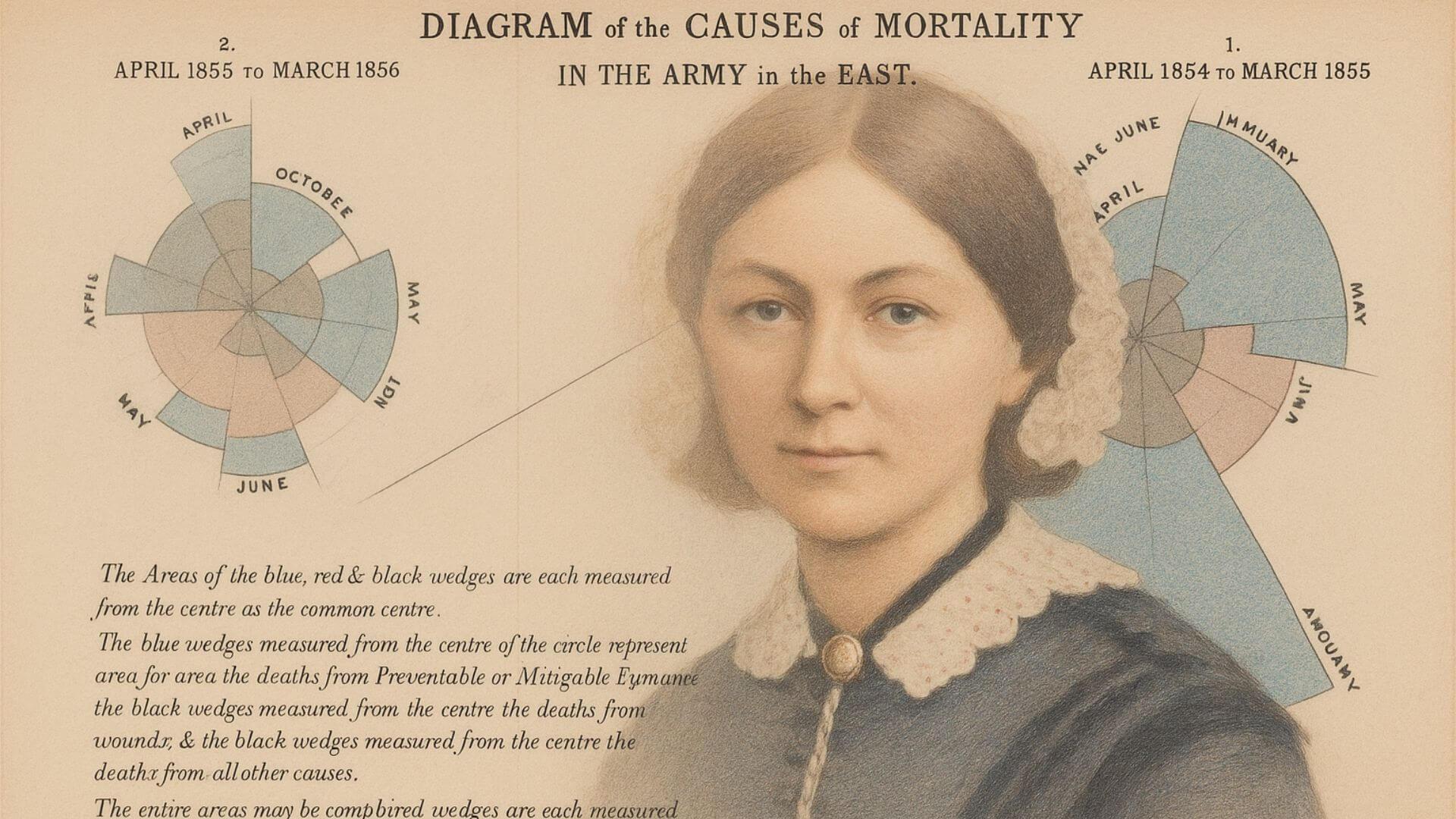
Beyond the iconic nighttime image with a lamp, his fundamental legacy was methodological: the systematic use of data and graphs to persuade and reform. His statistical diagrams helped the public and governments understand the impact of hygiene on survival.
In 1860, she founded the Nightingale School of Nursing at St. Thomas' Hospital in London, professionalizing nursing education and raising ethical standards. Her influence extended worldwide as an advisor on healthcare and hospital design . In 1907, she was awarded the Order of Merit by the United Kingdom and continued working, as far as her health allowed, until her death in 1910.
Transversality: from the classroom to the real world
Why combine toilet paper, handwashing, and Nightingale in a single educational project? Because they link meaning: you manipulate objects to understand numbers, use physical models to explore healthy habits, and learn about a pioneer who combined hygiene and statistics to save lives. Mathematics becomes useful, accessible, and human.
This approach also fosters communication skills: students explain what they are doing, listen to each other, compare strategies, and then formalize their ideas. First they speak their own language, then they learn the language of mathematics , and both are necessary.
If you're carrying out these activities on a website or platform, it's important to understand cookies. There are technical cookies (for sessions, security, or forms), personalization cookies (language or settings), and analytics cookies (anonymous traffic and usage patterns). In some countries, the use of certain cookies requires explicit consent to comply with regulations.
Services like Google Analytics help improve websites by measuring visits and page views in aggregate, and users can disable tracking if they prefer. It's always advisable to explain how to enable or disable cookies in browsers and link to clear privacy policies.
Historical notes and sources
Parts of these ideas have been published at different times: some teaching practices were shared in the past decade in educational spaces, while models on hand washing appeared in the media in May 2023. Dating them helps to contextualize the discussion and understand its evolution.
For further information, you can consult an online academic paper that delves deeper into topics related to teaching mathematics and hygiene. Access the PDF . Reviewing reliable documentation enriches classroom practice.
Everyday arithmetic in healthcare
As an example of real-world data in documents and guides, logistical or editorial references sometimes appear with industrial or distribution addresses. A typical record would include the company name and location, such as a distribution unit in an industrial park in Azuqueca de Henares. Learning to read and interpret this metadata is also part of scientific literacy.
In schools, coordinating departments to agree on consistent guidelines prevents contradictory messages to students. Everyone working in the same direction multiplies the teachers' efforts and results.
If you'd like to take this approach a step further, try documenting your students' experiences and sharing them with your community. Sharing best practices accelerates teaching improvement and fosters a professional culture.
If you've ever been told that math is a drag, take advantage of it: a real drag can open doors to profound ideas. From counting with strips of paper to approximating π, from the rigor of units to rubbing your hands together , everything adds up to make math matter and be useful.
Table of Contents
- 1 What do we mean by hygienic mathematics?
- 2 Building numbers: composing and decomposing with a roll
- 3 Multiplication, commutative and division with equal strips
- 4 Divisors, greatest common divisor and prime numbers
- 5 Lowest common multiple: one run to tie
- 6 Rolling to π and geometry with cylinders
- 7 Low-cost manipulative materials and creativity
- 8 Doing science with rigor: common rules in the classroom
- 9 Step-by-step method for solving a problem
- 10 Physics of handwashing: time and strength matter
- 11 Florence Nightingale: Hygiene, Data, and the Healthcare Revolution
- 12 Transversality: from the classroom to the real world
- 13 A note on data, cookies and analytics
- 14 Historical notes and sources
- 15 Everyday arithmetic in healthcare
