- Homework is the children's responsibility; families support without replacing them.
- In Preschool, play is the priority; in Primary, organization and scheduling are the key elements.
- Avoiding common mistakes (over-helping, nagging, chaos) improves the study environment.
- The law establishes the rights and duties of families and children and the resulting responsibilities.
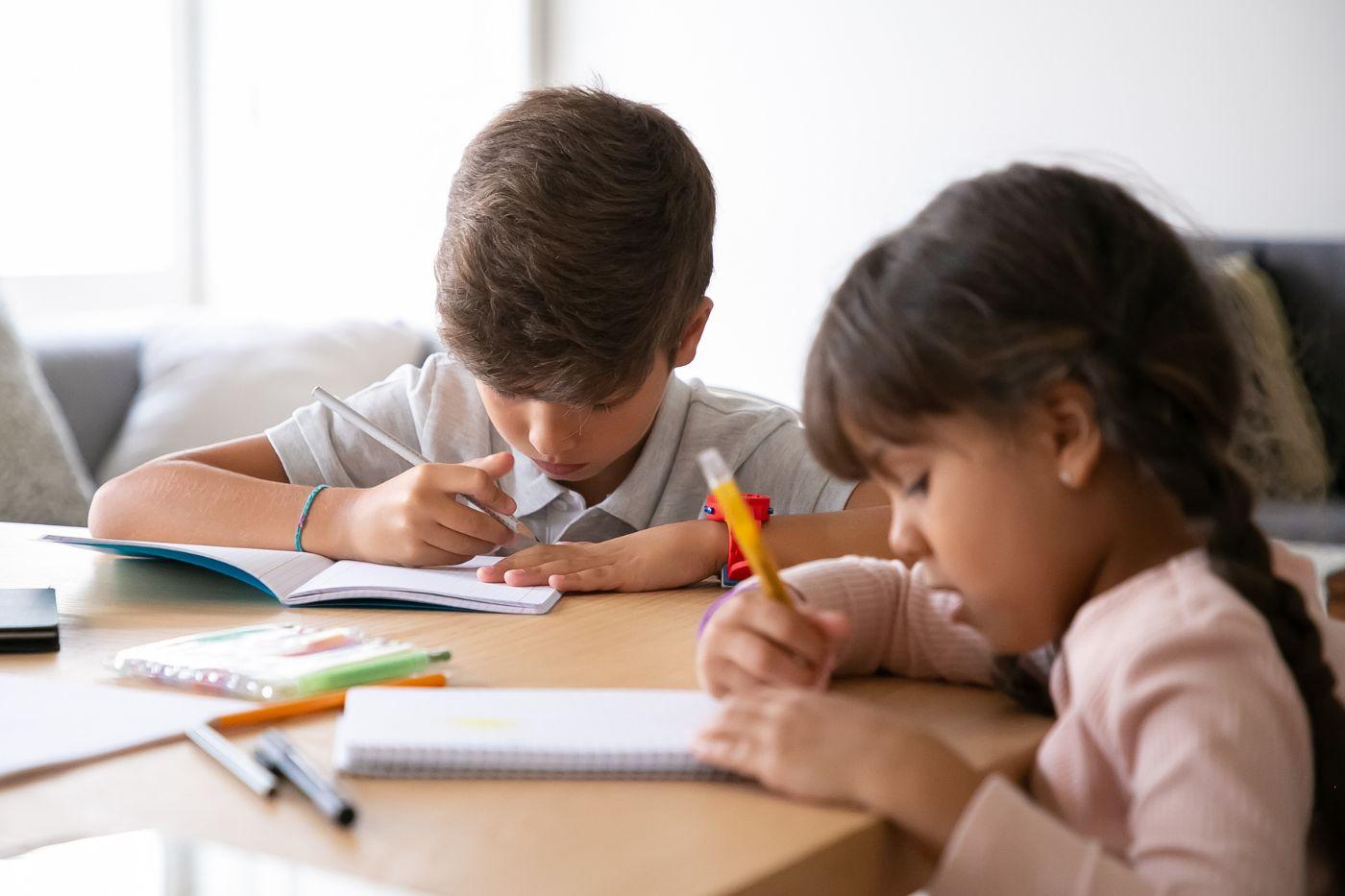
In many homes, homework time has become a minefield. Between those who argue that homework reinforces learning and those who advocate for reducing it, the real daily question is: who is responsible for homework, the children or the parents? This debate is crucial, because the answer affects students' autonomy, the family atmosphere, and even the relationship with the school.
The evidence provided by schools, families, and professionals is consistent: homework is the responsibility of children , and the adult role should focus on offering context, organization, and emotional support, without taking over or replacing their work. This difference—seemingly subtle—completely changes the dynamics at home and in the classroom, and prevents something crucial: the child feeling that they are only capable if their mother or father sits by their side all the time.
Whose homework is it really?
The most widespread view in current educational literature holds that homework belongs to the student: sons and daughters are the ones who bear that responsibility . It is up to adults to accompany them, monitor their reasonable completion of assignments, answer specific questions, and, above all, not interfere with their own trial-and-error process. “Putting on the coach's tracksuit”—organizing and advising to improve performance without running the race for the player—is a very useful metaphor for understanding the role of families.
This approach contrasts with a measurable reality. According to a survey of study habits in Spain, 80% of primary school students and 45% of secondary school students receive help at home . The increased education of families and better work-life balance have led many households to become more involved. But this good intention has a downside: the parent-child relationship can become overly focused on schoolwork, with everything revolving around grades and homework , while values, play, and personal responsibility are sidelined.
One non-negotiable point: don't do their homework for them . Nor is the goal to correct them exhaustively. What's important is that they try, make mistakes, learn where they're going wrong, and bring that learning to class so the teacher can intervene. Over-helping creates dependency and reinforces the implicit message of "you can't do it alone."

Preschool: play, development, and no rush with the worksheets
In Early Childhood Education, the priority is different: homework is unnecessary . This stage is ideal for learning through play, because play activates essential cognitive processes (attention, memory, coordination, fine motor skills, processing speed), and, moreover, positive emotions help solidify learning . Nothing beats the park, traditional games, and free play for developing the foundations that will support their later success.
Free, screen-free play is a training ground for executive functions : those abilities that allow us to anticipate, plan, inhibit impulses, keep the goal in mind, and adjust our behavior to achieve it. Those who learn to make decisions, organize, and persevere from a young age will find independent study easier when real assignments arrive.
To maximize the potential of play, variety is key: with other children (negotiating what to play, respecting rules, resolving conflicts), with family (improving communication and building trust so they can share concerns), and alone (learning to entertain themselves, gaining confidence, and practicing self-regulation). Avoid endless lists of extracurricular activities: less is more at this age.
Elementary: homework and organization begin
With primary school comes homework, and with it, the perfect opportunity to model autonomy: letting them know what needs to be done . In this regard, be wary of WhatsApp groups of families that act as the student's primary source of homework information: if children perceive that they don't need to record their assignments because an adult asks for them, their sense of responsibility diminishes.
The key tool for organizing your daily life is a planner . Working memory is limited (even more so in childhood), so an external aid frees up mental space, prevents forgetfulness, and helps you develop planning skills. A planner isn't just a decoration; it's a way of life.
How to use your planner wisely
- Take care of the support: without torn pages, scribbles, or stains. Aesthetics also teaches order.
- Write legibly and neatly, so that anyone can understand what's written. If you don't read it, it doesn't exist.
- Write down everything relevant: exams, excursions, medical appointments, birthdays, meetings… don’t miss a thing.
- Record everything on its actual date, not the day someone said it. The calendar rules.
- Plan the eveIf there's a start date on the 11th, the 10th says "Pack your backpack, water, and sandwich." If there's an art test on the 10th, the 9th says "Check your equipment: ruler, set square, protractor, compass, technical markers..."
- Record assignments and exam content by subjectRelying on memory is a recipe for forgetting.
- Use a color code: for example, exams in red, exits in green, homework in blue.
- Contrast with a partner to check that nothing is missing.
- Mark with a tick as completed to see the progress and be motivated with each milestone.
Ten common mistakes families make with homework (and alternatives)
Evenings can be complicated by unhelpful habits. Let's review ten common mistakes and what to do instead to make your routine run more smoothly.
- Do tasks anywhere (noisy kitchen, living room with TV on). Alternative: give them a fixed and quiet place, better if it is your study corner, and avoid distractions.
- Complaining about the amount or type of homework. Alternative: accept what is happening at home And if it's excessive, talk to the school; at home, the teacher's agreement is respected.
- Let's do the exercises ourselves. Alternative: we neither make them nor perfect them; that they try, make mistakes and have doubts. It is advisable to check that they have corrected in class.
- View homework only as new content. Alternative: understand them as reinforcement and independent practiceIt's better to guide you towards where to find the answer (books, notes, resources) than to give it away.
- Set up the “daily scolding”. Alternative: serene climate and, in case of difficulties, collect them to consult them later with the teaching staff.
- Ignoring their need for presence. Alternative: leave your cell phone and to be available when they demand attention.
- Absolute control and constant examination. Alternative: If they ask us to teach them a lesson, fine; if it creates tension, trust in your responsibility and verbalize that trust.
- Avoid school-family dialogue. Alternative: fluid collaboration with teachers and ask for extra support if needed.
- Accumulating extracurricular activities and arriving exhausted. Alternative: Adjust activities to your interests and leave afternoons free to play and study without rushing.
- Anarchic operation. Alternative: regular routine (same time and place, mobile phone out) to train self-discipline.
Organizing time: breaks, order, and realism
It's helpful to set an approximate start and end date for tasks; putting a clock on the table helps visualize time. Sustained attention has limits: in childhood, it rarely lasts more than 40 minutes.
Between work sessions, short breaks of 10-15 minutes are recommended , especially when transitioning from one demanding activity to another. It's preferable that these breaks be truly restorative (stretching, drinking water, doing some light movement) and not screen time.
The order of tasks matters. It usually works to start with something short and manageable , then tackle the more demanding tasks, and leave the most enjoyable or easiest for last. Peak performance is often reached around 30 minutes; it starts to decline after an hour and a half.
The following age-based guidelines are a good compass (always adjusting to each case): younger children , 15 minutes of reading or calculation; 6-8 years , 30-40 minutes; 8-10 years , about an hour; from 10-12 years , between 60 and 90 minutes; High school , 2 to 3 hours spread with breaks.
Family WhatsApp: Autonomy, School, and Limits
A common scenario: when a child is unsure about their homework, an adult asks in the parents' group . The result: the child learns that they don't have to figure it out themselves. And if the next day they go to school without those three subtraction and three division problems, they'll experience the natural consequence, gaining independence and developing a better memory for the future.
Furthermore, labeling them with phrases like "you know how they are" damages their self-esteem and self-concept . Calling them absentminded or a disaster creates a self-fulfilling prophecy that negatively impacts how they approach school.
There's also an impact in the classroom. If the family "solves" the problem outside the home without the teacher's knowledge, valuable information for assessing the student's autonomy and maturity is lost . It's not just about doing the math; it's about learning to take ownership of their learning process.
Another classic: “Do it the old way, it’s easier.” In mathematics, for example, subtracting by “asking” is the end of a learning process that involves manipulating, representing, and symbolizing , as explained in the learning phases formulated by Jerome Bruner. Interfering with this process disorients the child and hinders methodological consistency.
The alternative is clear: support rather than replace . It's better to say "show me how you do it" than "do it my way." If something isn't understood, coordinate with the teachers, without taking over their work or the students' responsibility.
Family involvement yes, but without generating dependency
Getting involved doesn't mean sitting down every afternoon to do exercises with them. Doing it systematically reinforces the idea that they can't do it without us . Effective help is intermittent, calibrated, and has a way out: organizing, suggesting strategies, and removing the "training wheels" as soon as possible.
There is also an equity factor . Social and cultural background influences performance. Families with higher levels of education can provide support for more years, and those with financial resources can access private tutoring or academies . If the burden of instruction is shifted to the home, we amplify inequalities. For this reason, many specialists suggest that most guided practice should take place at school, with teacher supervision, and that homework should be tailored and individualized (for example, reinforcing reading if that is the area of difficulty).
Practical tips for a healthier study environment
Small adjustments can completely transform the homeschooling experience. These simple yet powerful guidelines reduce stress and give children back control over what they can and can do.
- Structure routines: Build schedules that respect your biorhythm and needs.
- Meaningful pauses: Intersperse short, pleasant breaks between demanding tasks.
- An agreed space: choose and maintain a place to work, tidy and with what is necessary.
- Habit, not punishment: present homework as a normal part of the day, without drama.
- Less pressure: give time to think and organize before intervening.
- Don't fix everything: value content and effort and let mistakes teach.
- Genuine interest: ask what they have done and what they have thought while doing it.
- Taking care of the emotional: listen to their frustrations and joys, without minimizing them.
Legal rights and duties of families and children
In parallel, families, as the primary caregivers, have responsibilities: ensuring their children complete compulsory education and attend school regularly ; providing, to the best of their ability, the resources and conditions necessary for academic progress; encouraging the completion of assigned study activities; actively participating in the school's educational commitments; understanding, supporting, and monitoring their children's educational progress in collaboration with the teaching staff; respecting and upholding school rules and the authority of the teaching staff; and fostering respect for the entire school community. Furthermore, the authorities must facilitate the right of families to form associations and federations.
The Civil Code also outlines the obligations of children towards their parents: to obey for the duration of parental authority and to always show respect , even afterward, without this implying unconditional submission. Furthermore, while living in the home, they must contribute equitably and according to their means to the family expenses.
Regarding liability for the actions of minors, parents and, where applicable, guardians are liable for damages caused by children under their parental authority , by virtue of their duty of supervision. This liability ceases if they prove that they acted with the diligence expected of a prudent parent to prevent the damage. If a crime is involved , the law stipulates that civil liability will be levied against the parents' assets, with a statute of limitations for civil liability actions that, within the aforementioned general framework, is set at 15 years.
In this context, what has already been said makes sense: the family accompanies and supports, but does not assume the role of the student or the teacher. The school evaluates, guides, and corrects; the home provides conditions, habits, and values.
To go a step further, many schools are encouraging students to tailor their homework to their individual needs (for example, providing extra reading for those who need it or offering specific math practice) rather than assigning the same amount of homework to everyone. This approach reduces stress and makes every minute of homework meaningful.
Allowing homework to be an opportunity to develop autonomy and responsibility , reducing unnecessary pressure, and focusing on the process rather than the perfect result, contributes to a more harmonious family atmosphere. It's about integrating study with play, conversation, and shared life, and ensuring that everyone—student, family, and school— plays their appropriate role.
Table of Contents
- 1 Whose homework is it really?
- 2 Preschool: play, development, and no rush with the worksheets
- 3 Elementary: homework and organization begin
- 4 Ten common mistakes families make with homework (and alternatives)
- 5 Organizing time: breaks, order, and realism
- 6 Family WhatsApp: Autonomy, School, and Limits
- 7 Family involvement yes, but without generating dependency
- 8 Practical tips for a healthier study environment
- 9 Legal rights and duties of families and children
