- The UGR publishes calls for PTGAS and competitions for access to teaching bodies following state regulations and its Statutes.
- The offers are organized by functional areas and teaching figures (assistant doctor, contracted doctor, associate, etc.) in multiple universities.
- University websites complement the calls for applications with news, information notes, process histories and youth employment programs.
- All of this is accompanied by cookie policies, accessibility and web standards that regulate data use and the browsing experience.
If you're looking for comprehensive information about job openings at the University of Granada (UGR), for both administrative and service staff, as well as faculty and researchers, this guide is perfect for you. Here you'll find, explained clearly and in accessible language, the same information typically published on the official websites of the UGR and other Spanish universities regarding selection processes, competitive examinations, youth employment opportunities, news, and even cookie policies.
The goal is to provide you with a single, organized, and easy-to-understand overview of how university applications work , the types of positions available, the stages of the application process, and other related information (such as information notes, accessibility guidelines, and data protection policies) that is typically found on institutional websites. It's not an official website, but it compiles and reorganizes all the content found on top-ranked pages so you know exactly what to expect when browsing them.
UGR Calls for Technical, Management, Administration and Services Staff (PTGAS)
The University of Granada has a dedicated section where all information regarding open recruitment processes for PTGAS (Technical, Management, Administrative, and Service Staff) positions is published. This section includes all competitive examinations and selection processes for entry into the various civil service categories at the University of Granada.
These calls for applications are made in accordance with the public employment offers (OEP) approved each year , as stipulated in the Organic Law of the University System and the university's own Statutes. Processes for non-research technical support staff linked to specific projects or programs are also published here.
It is important to understand that this section does not include information related to the creation of pools or lists of temporary staff that may arise as a result of a selection process. If you want to know how temporary positions are managed, the University of Granada (UGR) specifically directs you to another section: “Access to Public Employment: Temporary Staff,” accessible from the institution's homepage.
To facilitate planning, the university also publishes a schedule of dates for the first exam (or the single exam, if there is only one) of the selection processes. This schedule is organized by semester and serves as a general guide for those preparing for the exams.
However, the University of Granada (UGR) emphasizes that this forecast is merely indicative . The official and final exam dates are published on the specific page for each exam session, through the corresponding Rector's Resolution or the Examination Board's Agreement. In other words, the definitive schedule is always available on the specific page for each process.
Functional areas and examples of internal calls for applications
Within the process for civil servants, the University of Granada organizes calls for applications by functional areas or professional families . Each area may have active processes or, in some cases, appear without any open calls for applications at that time.
Among these functional areas, the following internal categories stand out, which are usually listed on the website:
- AF1.1 Administrative: purely administrative and management scope.
- AF1.2 Legal: positions with a legal or regulatory profile; sometimes it is expressly stated that there are no active calls for applications.
- AF1.3 Auditing and Analytical Accounting: positions focused on economic and financial control; it may also appear without open processes.
- AF2 Library: includes positions such as the Scale of Assistants of Archives, Libraries and Museums.
- AF3 Computing: positions related to information technologies.
- AF4.x: different sub-areas of support for teaching, prevention and occupational health, communication, international relations, university extension, sports management, conservation and maintenance, social responsibility and equality, and general services.
Sometimes, next to one of these areas, the website states that "there are currently no open positions in this Functional Area ," so the list acts as a stable framework and is only filled with specific positions when they are approved and published.
As a representative example, in area AF2 (Library), an open competitive examination has been published for entry into the Auxiliary Scale of Archives, Libraries, and Museums , with a specific number of positions (for example, 17) referenced to a resolution of a certain date. This type of information is always displayed with the text of the call for applications, the number of positions, and the date of the resolution approving it.

Competitions for access to university teaching positions at the UGR
In addition to administrative and service staff positions, the University of Granada publishes open competitions for entry into university teaching positions . These competitions are designed for tenured faculty (for example, associate professors or full professors) and are governed by very specific regulations.
The official pages explain that the UGR will convene these competitions in accordance with the provisions of Organic Law 2/2023, of March 22, on the University System (published in the BOE no. 70 of March 23) and Royal Decree 678/2023, of July 18, on state accreditation for access to these teaching bodies and the regime of the competitions themselves (BOE no. 213 of September 6).
It is also worth noting that the internal regulations stem from Article 114 of the Statutes of the University of Granada , approved by Decree 231/2011 of July 12, issued by the Governing Council of the Regional Government of Andalusia and published in the Official Gazette of the Regional Government of Andalusia (BOJA) No. 147 of July 28. This entire legal framework defines both the admission requirements, including the need for specific accreditations such as language proficiency , and the procedures for conducting competitive examinations.
The corresponding section provides an updated list of competitions for access to teaching positions that are in any of the phases of the process : publication of the call, submission of applications, provisional and final lists of admitted and excluded persons, designation of tribunals, dates of holding the tests, proposals of provision, etc.
The typical structure of each competition form includes key information such as teaching staff, area of knowledge, department, type of dedication and reference to the resolution that approves it, as well as links to official documents (rules, list resolutions, results, etc.).
Calls for applications for teaching and research staff at Spanish universities
The analyzed content includes a very long list of calls for applications for university teaching positions at practically all Spanish public universities . Although this information is not limited to the University of Granada (UGR), it does illustrate very well how these positions are structured and what types of positions are typically available for teaching and research staff.
In that repertoire, figures such as Assistant Professor, Contracted Professor, Associate Professor (including variants such as associate professor of assistance or health sciences), permanent labor professor, reading professor, associate professor, contracted professor, university professor or tenured university professor, among others, are repeated time and again.
Calls for applications are usually presented with a standard format: type of teaching position, issuing university, call reference, and publication date . In many cases, a numerical identifier (“Call 1901,” “Call 1655,” etc.) is also used as an internal reference for quickly locating the information on the job portal or in the corresponding official gazette.
This extensive list covers a broad timeframe, with references that have been appearing for years at numerous universities, including León, Salamanca, Alicante, Valencia, Seville, Murcia, Oviedo, Córdoba, Valladolid, Jaén, Cádiz, the Polytechnic University, Miguel Hernández University, the Autonomous University of Madrid, the Public University of Navarre, Burgos, La Rioja, Zaragoza, Santiago de Compostela, Rovira i Virgili University, Pompeu Fabra University, Girona University, the Balearic Islands University, the University of Extremadura, and many more. A continuous flow of job offers for faculty positions in various categories is evident.
In practice, for the candidate this means that the world of university calls is not limited to their own institution: it is common to simultaneously follow the portals of several universities and platforms that compile all these offers, so as not to miss opportunities in related areas of knowledge.
Information notes, news and calls for proposals have ended
University websites not only publish open calls for applications; they also offer specific sections for "News," "Information Notes," and "Closed Calls for Applications ." These sections are essential for understanding the context and evolution of employment and research at each institution.
The case study mentions a news section where it's possible to filter publications by topic (grants, scholarships and contracts, internal development plans, etc.). This allows teaching, research, and administrative staff to quickly find the information they're actually interested in, without having to sift through all the university's news.
Information notices are typically sent to institutional mailing lists such as “infougr” at the University of Granada, which primarily includes people with official UGR accounts. This list is used to distribute relevant information about calls for applications, regulatory changes, deadlines, and other matters that directly impact the university community.
There is also a section for "Completed Calls for Applications ," which compiles processes that have already concluded but for which information sheets are still available. This history is especially useful for those who want to see the type of profile that has been sought, the number of positions offered, or the frequency with which certain teaching roles have been offered.
Finally, there is a specific contact form for inquiries about grants, projects, and human resources in research. This form is used to address questions about requirements, deadlines, documentation, or technical issues with the application process.
Youth Guarantee programs and youth employment at the UGR
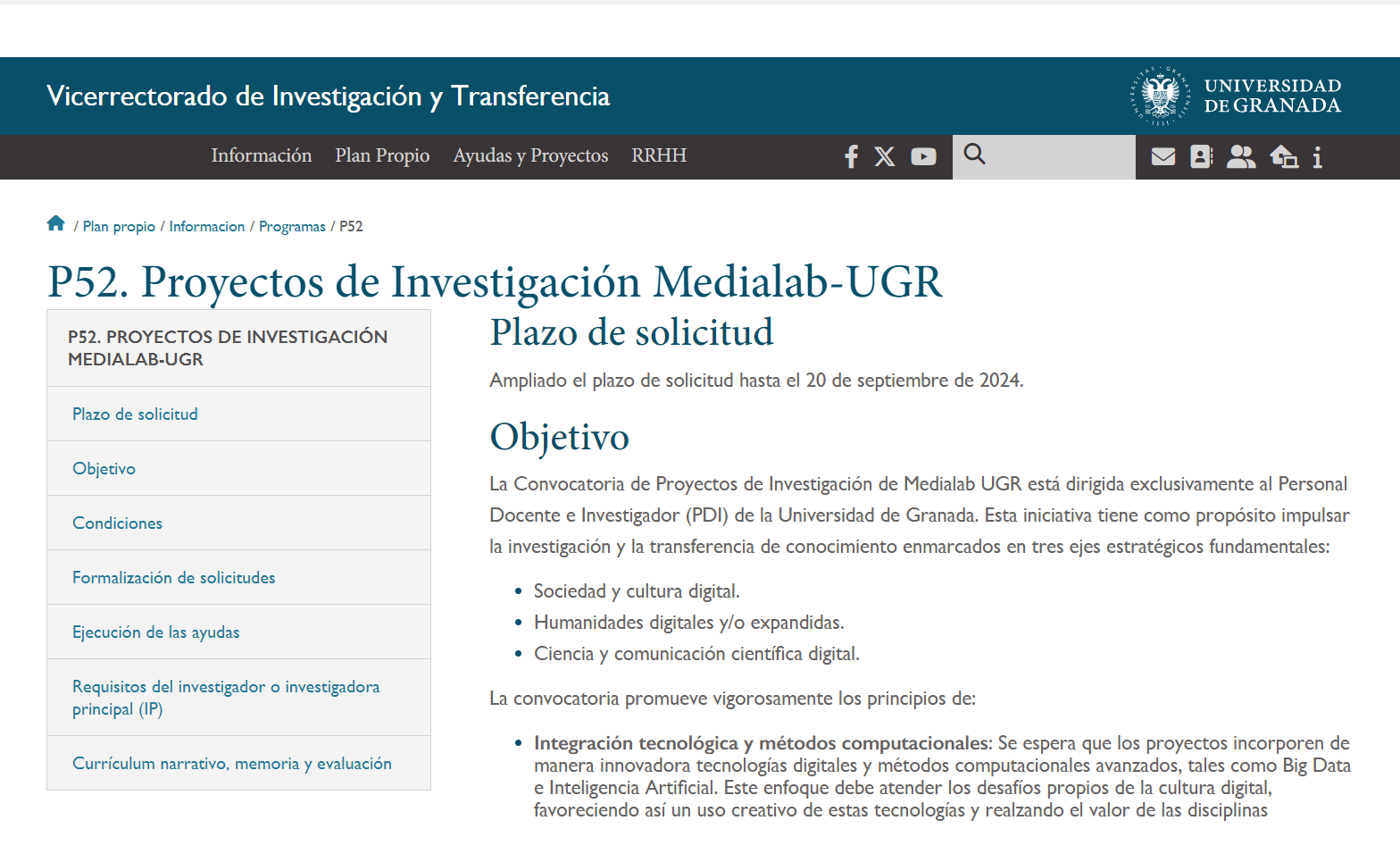
Within the University of Granada's ecosystem of opportunities, there are also specific youth employment programs linked to the Youth Guarantee . These programs are managed by the Vice-Rectorate for Research and Transfer and are designed to facilitate the integration of young people into the university environment, typically through research or administrative support contracts.
The contents include specific references such as “Reference 9090: Zoology Collections Laboratory” or “Reference 10072: Vice-Rectorate for University Extension, Heritage and Institutional Relations” . Each of these references identifies a specific position or project funded within the framework of youth employment programs.
The university reminds everyone that all the detailed information about these offers (terms, requirements, application deadlines, selection criteria) can be found on the research portal, specifically in the human resources and Youth Guarantee section, where these calls for applications are centralized.
This type of program fits into a broader strategy of promoting youth employment and supporting emerging research careers , which combines external funding (European, state or regional funds) with the existing structure of university groups and services.
Cookies policy on the University of Granada website
Like any modern institutional website, the University of Granada's portal incorporates a clear and detailed cookie policy , the aim of which is to explain to the user what information is collected during browsing and for what purpose it is used.
This policy defines a cookie as a small piece of text that websites send to the browser , allowing them to remember visit data, such as preferred language or other settings. This makes subsequent visits faster and more personalized, contributing to an improved user experience.
The University of Granada (UGR) differentiates between several types of cookies based on various criteria. Firstly, it distinguishes between first-party cookies and third-party cookies , depending on who manages the domain that sends them and processes the data. Secondly, it differentiates between session cookies (which are deleted when the browser is closed) and persistent cookies (which remain for a specific period of time).
Furthermore, the classification by purpose is explained, mentioning technical, personalization, analytical, advertising, and behavioral advertising cookies . This categorization follows the guidelines set out in the Guide on the Use of Cookies by the Spanish Data Protection Agency, which is cited as an additional reference for those who wish to learn more.
The UGR website uses, among other services, Google Analytics as a web analytics tool . This service allows us to measure and analyze user browsing behavior, providing data such as number of visitors, pages viewed, frequency of visits, average duration, browser type, internet service provider, language, device, and city of origin (based on IP address).
It is clarified that, to guarantee anonymity, Google anonymizes IP addresses by truncating them before storing them , so Analytics is not used to personally identify visitors. Only in cases of legal obligation may Google share the collected information with third parties, and according to the terms of service, IP addresses are not associated with other data held by Google.
In addition to these analytics cookies, the University of Granada (UGR) downloads its own technical cookie called “cookie_agreed” , a session cookie. Its function is to manage the user's consent regarding the use of cookies: basically, to remember who has accepted so as not to keep showing the notice at the bottom of the page every time they access it.
Finally, users are informed that they can restrict, block, or delete cookies from the University of Granada (UGR) or any other website using their browser settings. Since each browser works differently, it is recommended to consult the browser's built-in help function for specific instructions.
Accessibility, web standards and institutional footer
The analyzed pages also show a section designed to meet the minimum requirements for corporate image and accessibility . This section includes several elements that typically appear in the footer of UGR websites.
These elements include a text-based copyright link pointing to the University of Granada's main website , using the phrase "© University of Granada". Following this, a contact email address is provided for those responsible for the content of the specific site the user is visiting.
It also links to the website's accessibility information , which explains the measures taken to ensure the pages are usable by the widest possible range of people, including those with disabilities. There is also a link to the dedicated privacy policy page, which details the processing of personal data.
Regarding technical standards, it is indicated that the page uses XHTML 1.0 and CSS 2 specifications , and that efforts are made to ensure that the code is syntactically and semantically valid to comply with the accessibility recommendations contained in the WCAG (Web Content Accessibility Guidelines) of the W3C (World Wide Web Consortium).
This commitment to standards and accessibility is not a mere formality: it facilitates the correct display of pages on different browsers and devices , improves the user experience for people with screen readers, and helps to make content more sustainable in the long term.
With all of the above, the sections on calls for applications, teaching competitions, youth employment programs, news, information notes, cookie policy and accessibility notices of the University of Granada and the group of Spanish universities paint a very broad ecosystem of job, academic and research opportunities , supported by a web structure that seeks to be clear, regulatory and respectful of data protection and user experience.